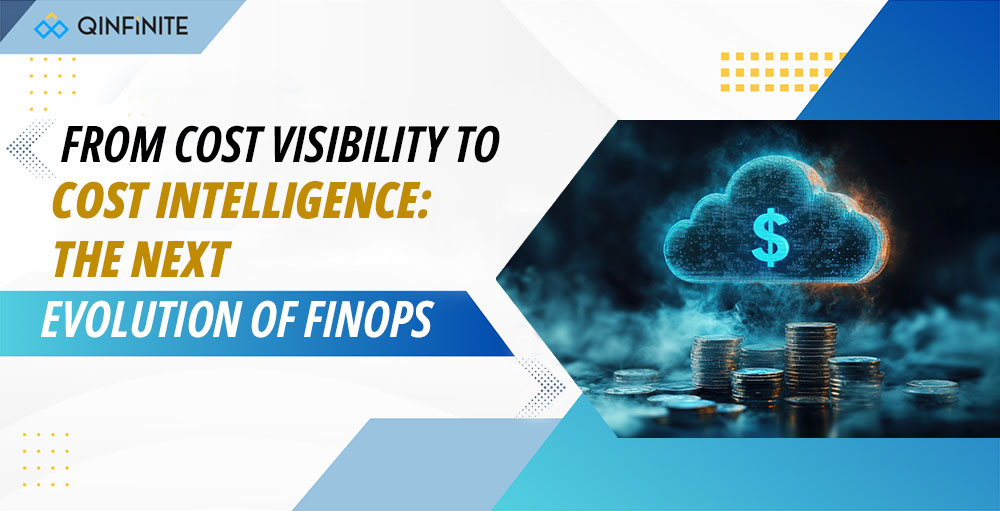
We Can See More Than Ever. So Why Do We Still Struggle?
Introduction
Over the last few years, enterprises have made significant progress in managing cloud cost.
They’ve invested in FinOps.
They’ve built dashboards.
They’ve created processes for tracking and accountability.
And today, most organizations can confidently say:
“We have visibility into our cloud spend.”
But then comes the real test.
- A spike in cost.
- A performance issue linked to resource changes.
- A decision that needs to balance cost with reliability.
And suddenly, visibility doesn’t feel like enough, because seeing the numbers is one thing and understanding what to do next is something else entirely.
The Visibility Plateau
There’s a point most organizations reach – often without realizing it where they have:
- Detailed cost breakdowns
- Trend analysis
- Allocation across teams and services
But despite all of this, they still struggle to:
- confidently reduce cost without risk
- explain cost fluctuations clearly
- align engineering decisions with financial outcomes
This is what we can call ‘The Visibility Plateau’.
You can see more, but you don’t necessarily understand enough.
Why Visibility Alone Falls Short
At its core, cloud cost is not just a number. It is the outcome of how systems behave.
And modern systems are:
- interconnected
- dynamic
- constantly evolving
So when you look at cost in isolation, you’re missing the bigger picture.
You might see:
- a spike in compute
- an increase in storage
- a rise in network usage
But without context, these are just symptoms not explanations.
From Seeing Cost to Understanding It
This is where the shift begins.
From:
Cost Visibility → Cost Understanding → Cost Intelligence
Understanding means:
- knowing which applications drive cost
- seeing how services interact
- identifying what triggered changes
- evaluating impact before acting
It’s the difference between reacting to cost and managing it proactively.
The Missing Link: Context
If there’s one thing that separates visibility from intelligence, it’s ‘Context’.
Context connects:
- cost to applications
- applications to infrastructure
- infrastructure to business outcomes
Without it, decisions remain:
- reactive
- fragmented
- and often risky
With it, something powerful happens:
Cost becomes explainable, Decisions become confident and ‘Optimization’ becomes continuous.
What Cost Intelligence Actually Looks Like
Cost intelligence is not just a better dashboard. It’s a fundamentally different way of operating.
It means:
- Real-time visibility, not delayed billing insights
- Dependency-aware analysis, not isolated cost views
- Business-aligned attribution, not just infrastructure metrics
- Continuous optimization, not periodic reviews
And increasingly it means ‘Automation that acts on insight’ safely and intelligently.
From Reactive FinOps to Intelligent Systems
Traditional FinOps operates in cycles:
- review cost
- identify issues
- take action
- wait for results
But modern environments move too fast for this model.
The future lies in systems that:
- continuously observe
- understand changes in real time
- identify inefficiencies instantly
- act proactively
This is where FinOps evolves into something more powerful and that is ‘a continuous, intelligent cost management system’.
The Role of AI – Done Right
AI is starting to play a role in this evolution. But not all AI is equal. Blind automation can create new risks:
- over-optimization
- unintended system impact
- loss of control
The real value comes from context-aware, governed AI that is characterised by
- Actions guided by system understanding
- Decisions aligned with policies
- Humans in control where it matters
Where Qinfinite Fits In
This is exactly where Qinfinite is positioned, not as a replacement for FinOps, but as its evolution.
By combining:
- continuous discovery of cloud environments
- dependency mapping across applications and services
- real-time cost intelligence
- and Agentic AI workflows
Qinfinite enables enterprises to move beyond visibility, into true cost intelligence.
So instead of asking:
“Where are we spending?”
You can answer:
“What is driving our cost and how do we optimize it safely?”
The Maturity Shift
If you step back, the evolution becomes clear:
Tracking → Visibility → Understanding → Intelligence → Value
Most organizations today are somewhere between ‘Visibility and Understanding’.
The next step is ‘Intelligence’
And that’s where real value begins.
Closing Thought
In a world where cloud environments are constantly changing, managing cost once a month is no longer enough.
Because the real opportunity isn’t just to see what you’re spending. It’s to continuously ensure that every dollar spent is aligned with value delivered.
Ready to move from visibility to true cost intelligence?
Discover how Qinfinite helps you understand, optimize, and control cloud spend with confidence.