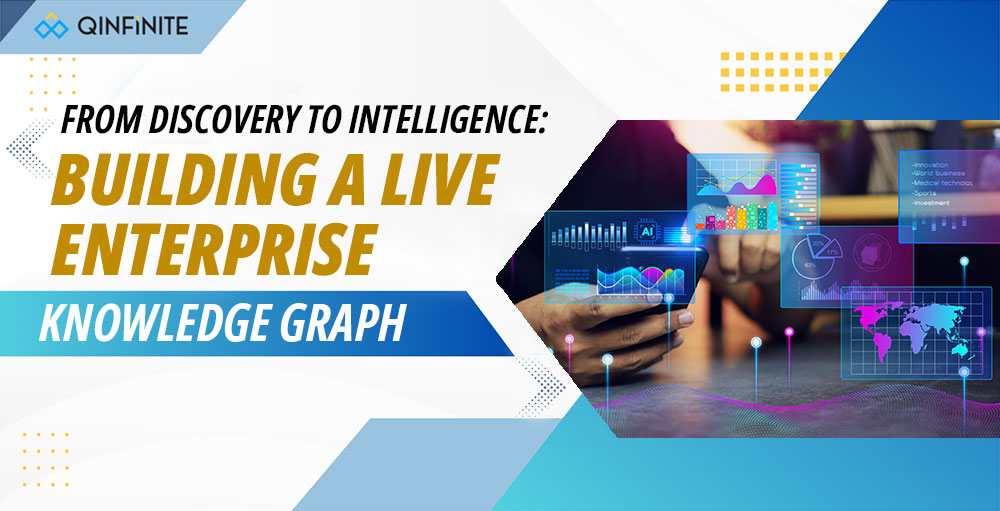
How modern enterprises are transforming visibility into real system understanding
It Starts with a Simple Problem
Ask any IT team:
“Can you map how all your systems are connected?”
Most will hesitate.
Not because they lack tools, but because modern IT environments are simply too complex. Applications span cloud and on-prem. Services depend on APIs and Infrastructure scales dynamically.
And most importantly:
Everything is connected — but not always visible.
The Limits of Traditional Discovery
For years, enterprises have relied on discovery tools and configuration management databases (CMDBs) to understand their environments.
These approaches were built for a different era — one where:
- systems were stable
- infrastructure changed slowly
- dependencies were simpler
Today, that’s no longer the case.
Modern IT environments are:
- dynamic
- distributed
- constantly evolving
As a result, traditional discovery creates:
- incomplete system maps
- outdated configurations
- disconnected views of infrastructure and applications
What enterprises end up with is visibility, but not understanding.
Why Discovery Alone Isn’t Enough
Discovery answers an important question:
“What exists?”
But it doesn’t answer:
- How are systems connected?
- What depends on what?
- What happens if something fails?
Without this layer of understanding, IT teams are forced to:
- troubleshoot in silos
- rely on tribal knowledge
- manually trace issues across systems
This slows down operations and increases risk.
The Missing Link: Intelligence
To move forward, enterprises need to go beyond discovery. They need to transform raw system data into intelligence.
This requires:
- connecting systems and dependencies
- understanding relationships in real time
- continuously updating how systems interact
This is where the concept of a Live Enterprise Knowledge Graph comes in.
What Is a Live Enterprise Knowledge Graph?
A Live Enterprise Knowledge Graph is not just a data repository.
It is a dynamic, connected model of your entire IT ecosystem.
It represents:
- applications
- infrastructure
- services
- APIs
- business processes
And most importantly: The relationships between them.
From Discovery to Knowledge Graph
Building a Knowledge Graph starts with continuous discovery and it doesn’t stop there.
Step 1: Continuous Discovery
Automatically detect systems across cloud, on-prem, and hybrid environments.
Step 2: Dependency Mapping
Identify how applications, services, and infrastructure interact.
Step 3: Relationship Modeling
Create a connected graph that represents real system behavior.
Step 4: Real-Time Updates
Continuously evolve the model as systems change.
Step 5: Contextual Intelligence
Enrich system data with meaning, context, and operational relevance.
This is the transformation:
Discovery → Relationships → Context → Intelligence
Why This Matters in Real Operations
Once systems are connected through a Knowledge Graph, everything changes.
Faster Root Cause Analysis
Instead of chasing alerts, teams can trace issues across dependencies instantly.
Better Change Impact Analysis
Understand how changes will affect systems before they are deployed.
Smarter Automation
Automation workflows become context-aware and more reliable.
Improved System Resilience
Identify weak points and hidden dependencies before they fail.
Enabling the Next Layer: AI and Automation
A Knowledge Graph doesn’t just improve visibility —
it unlocks the next generation of IT operations.
When combined with AI, it enables:
- intelligent anomaly detection
- predictive insights
- automated remediation
This is where Agentic AI workflows come into play.
Instead of reacting to events, systems can:
- understand context
- make decisions
- take action
The Role of Digital Twins and Chaos Engineering
With a Knowledge Graph in place, enterprises can go even further.
They can create a digital twin of their IT environment — a real-time model that mirrors how systems behave.
This allows organizations to:
- simulate changes
- test failure scenarios
- run chaos engineering experiments
Without impacting production systems.
The Qinfinite Perspective
At Qinfinite, we see the Knowledge Graph as the core intelligence layer of modern IT. Through its Live Enterprise Knowledge Graph, Qinfinite transforms continuous discovery data into contextual system intelligence.
By connecting applications, infrastructure, and dependencies in real time, it enables:
- deeper system understanding
- faster decision-making
- AI-driven automation
This becomes the foundation for Intelligent Application Management (iAM) — where systems are not just monitored, but continuously understood and optimized.
The Bottom Line
Discovery gives you visibility. But visibility alone is not enough. Intelligence comes from connection, context, and understanding.
In a world where systems are becoming more complex by the day, the question is no longer:
“Do you know what you have?”
It is:
“Do you understand how it all works together?”
Because that’s where true intelligence begins.