The Assumption That No Longer Holds
For a long time, IT operations has been built around a relatively simple premise: if systems are functioning as expected, the business will function as expected. This assumption shaped how teams monitored environments, how incidents were prioritized, and how success itself was measured. System uptime, response times, infrastructure health – these became the proxies for business performance, and in simpler, more linear environments, this model largely held true.
When Complexity Breaks the Model
But enterprise systems today no longer operate in isolation, nor do they behave in predictable, linear ways. Modern businesses are supported by deeply interconnected architectures where applications, APIs, data pipelines, and infrastructure layers continuously interact in ways that are both dynamic and often opaque. A single customer action like placing an order, completing a transaction, accessing a service, may traverse multiple systems, each with its own dependencies and performance characteristics. In such an environment, the relationship between “system health” and “business outcome” is no longer direct. It is mediated by complexity.
The Limits of System-Level Visibility
This is where the traditional model of IT operations begins to show its limitations. Teams may have comprehensive visibility into individual components like servers, services, applications, but that visibility does not automatically translate into an understanding of how those components collectively support business processes. As a result, it becomes entirely possible for systems to appear healthy in isolation while the business experiences degradation in aggregate. Transactions slow down, customer journeys break, workflows stall; not because a single system has failed outright, but because something within the chain of dependencies is no longer functioning optimally.
The Gap Between Signals and Meaning
The challenge, then, is not the absence of data or even visibility. Most organizations today are not lacking in dashboards, alerts, or monitoring tools. The challenge is that these signals exist without sufficient context. They describe what is happening at a system level but rarely explain what it means at a business level. And when meaning is missing, interpretation becomes necessary. Teams are forced to manually correlate signals, trace dependencies, and infer impact, often under time pressure, and often with incomplete information.
The Cost of Operating Without Context
This gap between system visibility and business understanding has tangible consequences. Incident response becomes slower not because teams lack skill, but because they lack clarity. Prioritization becomes inconsistent because all alerts appear equally urgent without a clear sense of business impact. Communication between IT and business stakeholders becomes fragmented because each group is operating with a different view of reality. Over time, this misalignment introduces not just operational inefficiency, but strategic risk.
A Shift in Perspective: Toward BizOps
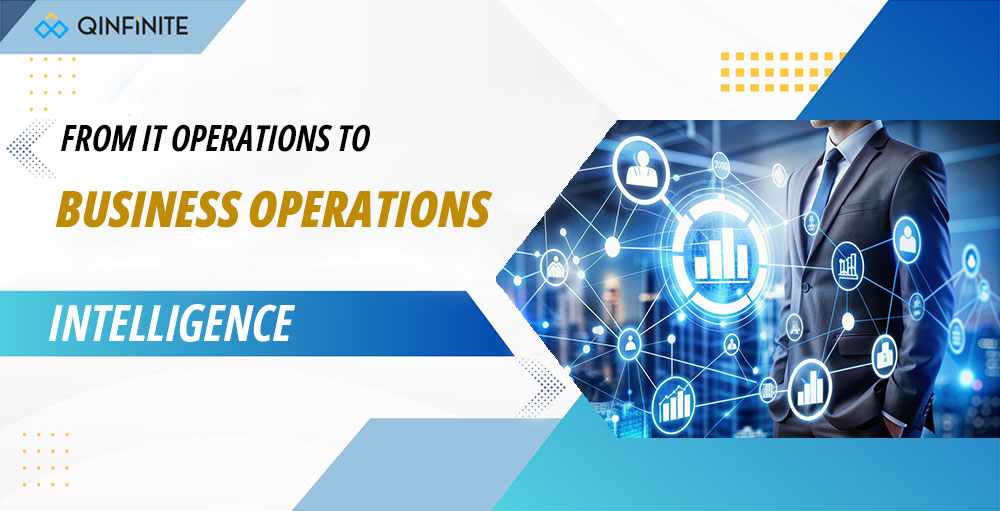
What is emerging in response to this challenge is a shift in perspective, one that moves beyond traditional IT operations toward what can be described as Business Operations Intelligence. This shift does not discard existing capabilities such as monitoring or observability; rather, it reframes them within a broader context. Instead of focusing solely on the health of individual systems, the focus moves toward understanding how those systems collectively enable business outcomes. The unit of analysis is no longer the component, but the service, the workflow, the outcome.
From Components to Relationships
This requires a different kind of visibility, one that is relational rather than isolated. It involves understanding how systems are connected, how dependencies are structured, and how changes or failures propagate across the environment. More importantly, it involves mapping these relationships to business services so that the impact of any issue can be understood in terms that matter beyond IT. In this model, an alert is no longer just a technical signal; it is an indicator of potential business disruption.
Why Static Approaches Fall Short
However, achieving this level of understanding through traditional means has proven difficult. Static approaches such as CMDBs, manual service mapping, or periodic documentation exercises struggle to keep pace with the rate of change in modern environments. Systems evolve, dependencies shift, and new services are introduced continuously. As a result, any static representation of the environment quickly becomes outdated, reducing its usefulness at the exact moment it is needed most.
The Need for Continuous Intelligence
What is required instead is a continuously evolving model of the enterprise, one that reflects the current state of systems, their relationships, and their connection to business outcomes in real time. This is not just a technical shift, but an operational one. It changes how teams perceive their environment, how they prioritize work, and how they make decisions under pressure.
Where Qinfinite Fits In
This is where platforms like Qinfinite introduce a fundamentally different approach. By continuously discovering systems, mapping dependencies dynamically, and linking them to business services, Qinfinite creates a living representation of the enterprise. This allows organizations to move from reactive interpretation to immediate understanding.
From Reaction to Clarity
When this layer of context is in place, the nature of operations changes in subtle but important ways. Incident response becomes more precise because impact is immediately visible. Prioritization becomes more consistent because it is grounded in business relevance rather than technical severity alone. Decision-making becomes faster because teams are no longer piecing together fragmented information, they are acting on a shared, contextual understanding of the environment.
The Real Shift
Ultimately, this shift reflects a deeper change in how IT is perceived within the enterprise. It is no longer sufficient for IT operations to ensure that systems are running; they must ensure that the business is running as intended. And that requires more than visibility. It requires understanding of relationships, of dependencies, and of impact.
Closing Thought
The question is no longer whether your systems are healthy.
It is whether you understand what that health actually means for your business.
Ready to move from system-level visibility to business-level understanding?
Discover how Qinfinite helps you connect systems, services, and outcomes, so your teams can operate with clarity, not assumptions.