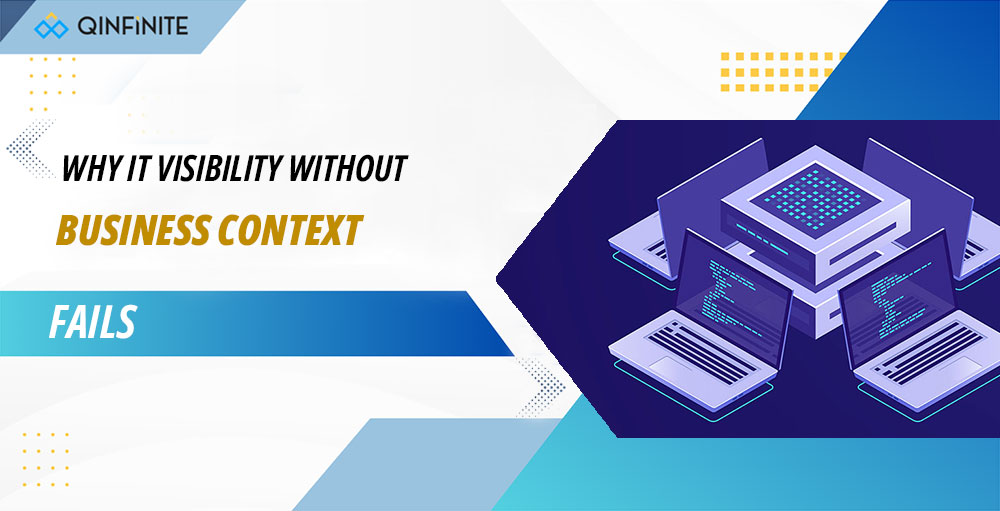
The Comfort of Seeing Everything
Over the years, IT teams have made real progress. There was a time when visibility itself was the problem. Systems were opaque, issues were discovered late, and teams operated with limited awareness.
That’s no longer the case. Today, most enterprises have dashboards, alerts, metrics, and monitoring tools that provide a constant stream of information. On the surface, it feels like control. You can see everything or at least, it seems that way.
When Something Breaks, the Real Question Emerges
And then something goes wrong like say:
- A system slows down.
- An API starts failing.
- A service becomes unavailable.
Alerts are triggered instantly and teams jump into action; but within minutes, the conversation shifts. Not toward the system – but toward the business, and the questions that begin to emerge are:
- Is this affecting customers?
- Are transactions failing?
- How critical is this right now?
- What is the business impact?
And that’s where things become less clear, because while the system issue is visible, the business impact is not.
The Gap Between Signals and Meaning
This is the gap most organizations don’t explicitly talk about. They have signals, data and visibility, but they lack meaning due to lack of context.
An alert might tell you that something is wrong with a service. It rarely tells you what that service means to the business. So teams are left to interpret, correlate, and often guess and in that time, decisions are delayed.
Why More Data Doesn’t Solve the Problem
The instinctive response to this gap is usually the same.
- Add more data.
- Add more tools.
- Add more dashboards.
But the problem isn’t the absence of data. It’s the absence of connection, because modern IT environments are not just collections of systems. They are networks of dependencies.
A single business workflow may span multiple applications, services, and infrastructure layers, and unless those relationships are understood, no amount of data can provide clarity.
When Everything Looks Important, Nothing Is Prioritized
Without business context, every alert feels urgent and every issue looks critical. Every team believes their problem should be addressed first and this creates a subtle but dangerous effect.
Efforts are spread thin while the focus is diluted and the issues that truly matter sometimes wait longer than they should.
The Cost of Misalignment
This isn’t just an operational inefficiency. It has the below real consequences namely:
- Critical business services may remain impacted longer than necessary
- Customer experience can degrade without immediate visibility
- Teams spend time on symptoms rather than root causes
- Trust slowly erodes along with the stock value
Because when IT cannot clearly communicate business impact, alignment becomes harder.
From Visibility to Understanding
The shift that organizations need is not from less visibility to more. Infact what they need is to be able to move from having deep visibility to gaining contextual understanding.
Having this understanding of how systems support business services and how failures propagate across inter-dependent entities of the business process is what’s going to define how you will effectively respond. This is the only understanding what truly matters at any given moment.
Where Qinfinite Makes the Difference
Qinfinite bridges this exact gap. By continuously discovering systems, mapping dependencies, and connecting them to business services, it provides the missing layer of context.
So when something happens, teams don’t just see it. They understand it, they know what it affects. This helps them to effectively prioritize with confidence.
The Bottom Line
Visibility is no longer the differentiator. Most organizations already have it.
The real question is:
Do you understand what you’re seeing?
Because that’s what separates awareness from control.
Ready to move beyond dashboards and understand real business impact?
Discover how Qinfinite connects your systems to business outcomes—so your teams don’t just see issues, they understand what matters.