Why enterprises are rethinking how they understand their systems
The Data Illusion
Walk into any enterprise IT environment today, and one thing is immediately clear:
- There is no shortage of data.
- Dashboards light up with metrics.
- Alerts fire in real time.
- Logs stream endlessly. Reports are generated at scale.
On paper, it looks like control.
But ask a simple question:
“Why did this incident actually happen?”
And suddenly, things get quiet.
Not because the data isn’t there —
but because it doesn’t tell the full story.
More Data, Less Clarity
Over the years, enterprises have invested heavily in:
- Monitoring tools
- Observability platforms
- ITSM systems
- Security solutions
Each one adds more visibility. More signals. More data points.
But instead of clarity, many teams experience the opposite:
- Too many alerts, not enough insight
- Faster detection, but slower resolution
- More dashboards, but fragmented understanding
The problem isn’t the volume of data. It’s the absence of context behind that data.
Why Context Changes Everything
Data tells you what is happening.
Context tells you why it matters.
Let us consider a simple scenario:
A spike in CPU usage is detected.
Without context, it’s just another alert.
With context, you understand:
- Which application is impacted
- Which services depend on it
- What business process is at risk
- What the downstream impact could be
- What the business and economic impact could be
That’s the difference between reacting to signals and understanding systems.
The Missing Layer in Modern IT
Most enterprise tools operate in silos.
- Monitoring tools track performance
- ITSM tools track incidents
- Security tools track threats
But none of them fully capture how systems are connected.
And in modern IT, connections are everything. Applications are no longer standalone. They are deeply interconnected ecosystems of:
- microservices
- APIs
- cloud services
- third-party integrations
A single issue can ripple across multiple systems, but without understanding relationships, that ripple is invisible.
From Data to System Intelligence
To truly power intelligent IT operations, enterprises need to move beyond data collection.
They need to build system intelligence.
This means:
- Understanding relationships between systems
- Mapping dependencies across applications and infrastructure
- Continuously updating how systems interact in real time
Instead of asking:
“What is happening?”
Teams can ask:
“What is happening, why is it happening, and what will it impact?”
Enter the Enterprise Knowledge Graph
This is where the concept of an Enterprise Knowledge Graph becomes critical.
A Knowledge Graph connects the dots.
It transforms fragmented data into a living, connected model of your IT environment.
It brings together:
- infrastructure
- applications
- services
- dependencies
- business context
into a single, dynamic view.
Why This Matters Now
As enterprises move toward:
- AI-driven operations
- automation at scale
- autonomous systems
the need for context becomes even more critical.
AI without context is limited.
It can detect anomalies —
but it cannot understand impact.
It can trigger actions —
but it cannot make informed decisions.
Context is what makes AI truly intelligent.
From Insight to Action
When context is embedded into your IT operations:
- Root cause analysis becomes faster and more accurate
- Incident response becomes proactive, not reactive
- Automation becomes smarter and more reliable
- Decision-making becomes grounded in reality
This is the shift from observing systems to understanding them.
How Leading Enterprises Are Moving Forward
Forward-looking organizations are beginning to rethink their approach.
Instead of layering more tools, they are:
- building continuous discovery models
- mapping real-time system relationships
- creating contextual intelligence layers
At the center of this transformation is the Knowledge Graph.
The Qinfinite Perspective
At Qinfinite, we see this shift as foundational to the future of IT.
Through its Live Enterprise Knowledge Graph, Qinfinite transforms raw operational data into contextual system intelligence.
By continuously mapping dependencies and relationships across your environment, it enables:
- deeper system understanding
- smarter automation
- AI-driven decision-making
This becomes the intelligence layer that powers Intelligent Application Management (iAM).
The Bottom Line
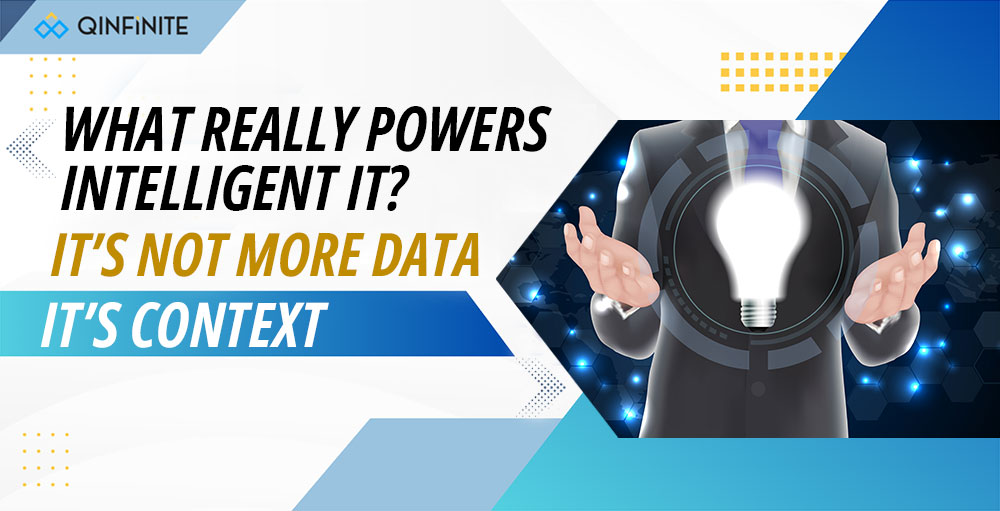
Enterprises don’t need more data. They need better understanding. Because in a world of increasing complexity, the winners won’t be the ones with the most dashboards.
They will be the ones who can answer this very simple question:
“How does everything actually work together?”