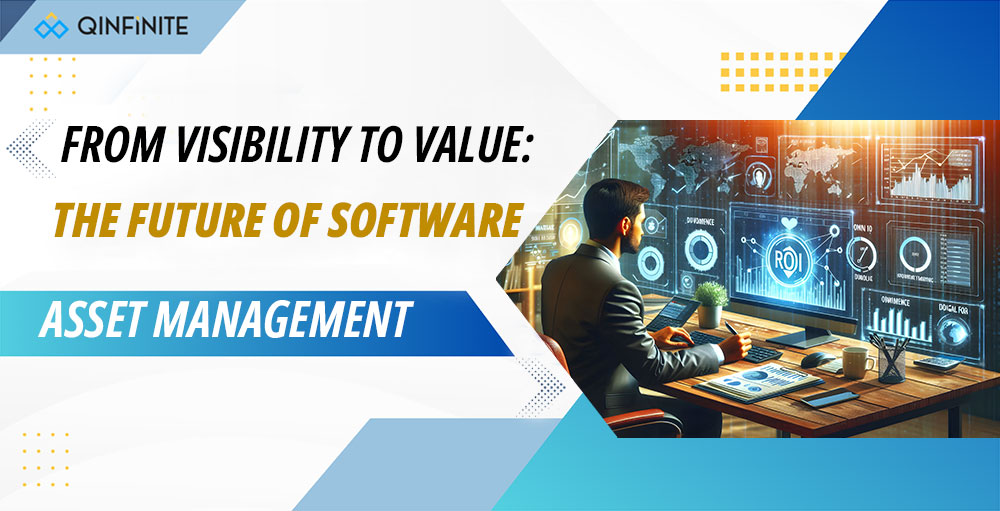
Knowing what you have is a start. Knowing what to do with it is where the real value begins.
Visibility Was the First Step
For years, Software Asset Management has focused on one core objective: ‘Visibility’, which answered the questions:
- What software do we have?
- Where is it installed?
- How many licenses are in use?
And to be fair, this was necessary, because without visibility, there is no control. But today, most enterprises have already crossed this stage at least partially. They have tools and dashboards as well as reports and yet the outcomes haven’t changed as much as expected.
The Visibility Plateau
Many organizations find themselves stuck in what can be called the Visibility Plateau.
They can see more but they still struggle to:
- reduce software spend consistently
- optimize license usage in real time
- make confident decisions
- align software investments with business value
Why?
Because visibility alone doesn’t answer the most important questions:
- What should we optimize?
- What can we safely remove?
- What is truly delivering value?
From Seeing to Understanding
The next stage in SAM evolution is not about more data. It’s about better understanding.
This is the shift:
Visibility → Understanding → Value
Understanding means:
- knowing how software is actually used
- identifying patterns across teams and systems
- connecting usage to business functions
- evaluating impact before making changes
Without this layer, visibility remains informative but not actionable.
Why Context Changes Everything
Software does not exist in isolation. It is connected to:
- users
- applications
- infrastructure
- business processes
Removing a license without context can:
- disrupt operations
- impact performance
- create unintended risks
This is why context is critical. It allows enterprises to move from:
“What do we have?”
to
“What should we do and what will happen if we do it?”
The Emergence of Intelligent SAM
This is where a new model namely Intelligent Software Asset Management begins to take shape. This model is built on three foundational capabilities:
Continuous Discovery
Always up-to-date visibility across dynamic environments.
Contextual Intelligence
Understanding how software is used and how it connects across systems.
Actionable Optimization
The ability to continuously optimize licenses, costs, and compliance.
Together, these transform SAM into a system that continuously creates value and not just reports it.
From Periodic Reviews to Continuous Optimization
Traditional SAM operates in cycles:
- quarterly reviews
- annual audits
- renewal-driven decisions
But modern enterprises are moving toward with ‘Continuous optimization’. This is where systems:
- monitor usage in real time
- identify inefficiencies instantly
- trigger optimization actions proactively
This eliminates the lag between:
insight → action → outcome
The Role of Automation and AI
As environments grow more complex, manual SAM simply cannot scale. This is where automation and increasingly, Agentic AI plays a role.
AI-driven systems can:
- analyze usage patterns across thousands of assets
- identify optimization opportunities instantly
- execute actions consistently across environments
The focus here is not replacing human oversight, but augmenting it by turning SAM into a self-improving system.
Connecting SAM to Business Value
The future of SAM is not just operational, it is strategic to the enterprise.
It connects directly to:
- FinOps → optimizing cloud and software spend
- Procurement → improving vendor negotiations
- IT Strategy → rationalizing applications
- Business Outcomes → aligning technology with value
This is where SAM evolves from:
cost tracking → value optimization
The Qinfinite Perspective
At Qinfinite, we see Software Asset Management as a critical part of a broader transformation.
Through its Intelligent Application Management (iAM) platform, Qinfinite enables enterprises to:
- continuously discover software across environments
- understand usage through a Live Enterprise Knowledge Graph
- automate optimization through Agentic AI workflows
This creates a system where:
- visibility is always current
- decisions are context-aware
- optimization is continuous
The Maturity Shift
The evolution of SAM can be summarized simply:
Inventory → Visibility → Understanding → Intelligence → Value
Most organizations today sit between ‘Visibility and Understanding’, but the future lies in ‘Intelligence and Value’.
Closing Thought
In a world where software is constantly changing, managing it once a quarter is no longer enough, because the real opportunity isn’t just to see what you have. It’s to continuously ensure that every software investment is delivering value across the entire application lifecycle for the enterprise.