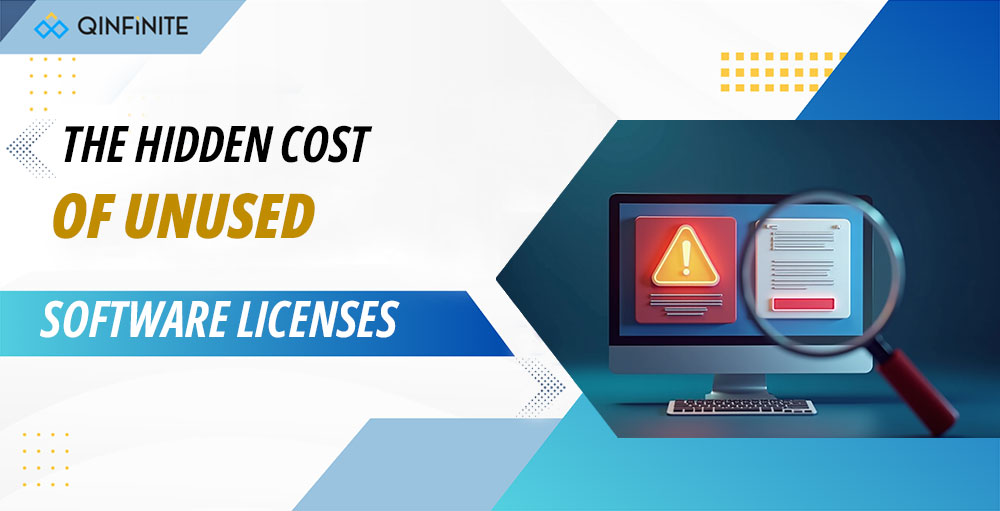
You’re not overspending on software. You’re overspending on what you don’t use.
The Cost You Don’t See
Every enterprise tracks software spend that looks at.
- Where budgets are allocated?
- What licenses are procured?
- What renewals are negotiated?
On paper, everything looks accounted for, but beneath the surface, there’s a different story unfolding:
A significant portion of software spend delivers zero value.
Not because the tools are bad or because the strategy is wrong, but simply because no one is fully tracking how software is actually used across the enterprise.
The Quiet Accumulation of Waste
Unused software doesn’t show up as a problem overnight.
It builds slowly.
- A team adopts a new tool – but keeps the old one
- Licenses are provisioned “just in case”
- Projects end, but subscriptions continue
- Employees leave, but access remains
Individually, these seem small, but collectively, they create a pattern that appears like a software sprawl without accountability.
The Visibility Gap
Most organizations believe they have visibility into their software estate. But as we’ve seen that traditional SAM tools capture only 60–70% of actual usage. So the question here is:
What’s missing?
- SaaS applications outside procurement
- Underutilized licenses across teams
- Idle subscriptions tied to inactive users
- Redundant tools solving the same problem
This creates a dangerous illusion:
“We think we know where the money is going.”
But in reality a significant portion is untracked or misunderstood.
When Licenses Outlive Their Value
One of the most common patterns in enterprise IT is that licenses are acquired based on anticipated need, but rarely adjusted based on actual usage.
Over time, this leads to:
- over-provisioned environments
- duplicate tools across departments
- licenses assigned but never used
And because renewals are often automated, inefficiency becomes a serious recurring cost.
The Real Business Impact
This isn’t just about IT budgets. It impacts the entire organization and is evident in the below forms.
Wasted Spend
Enterprises can waste 20–30% of software budgets on unused or underutilized licenses.
Inefficient Capital Allocation
Money tied up in unused software is money not invested in innovation.
Poor Negotiation Leverage
Without real usage data, vendor negotiations are based on assumptions—not facts.
Operational Friction
Teams spend time validating data instead of making decisions.
Over time, this creates a cycle that bleeds costs:
Over-provision → Under-utilization → Auto-renewal → Increased spend
Why This Problem Persists
If the problem is so visible, why hasn’t it been solved?
Because most tools focus on:
- tracking licenses
- reporting usage
- preparing for audits
But they don’t answer the most important question which is “What should or can enterprises do about it?”
From Visibility to Action
Solving software waste requires more than dashboards.
It requires:
- understanding actual usage patterns
- connecting software to users and business functions
- identifying optimization opportunities in real time
- taking action—quickly and consistently
This is where most organizations struggle, because Insight without action doesn’t reduce cost.
What Leading Enterprises Are Doing Differently
Forward-thinking organizations are changing their approach.
They are moving from:
Tracking Spend → Optimizing Value
Instead of reviewing software annually, they are:
- continuously monitoring usage
- identifying inefficiencies in real time
- reclaiming and reallocating licenses
- aligning spend with actual business needs
The Role of Intelligent SAM
This shift is enabled by a new model of Software Asset Management.
One that combines:
- continuous discovery (what exists)
- usage intelligence (what is actually used)
contextual - understanding (where it matters)
- automated action (what to do next)
This transforms SAM into a system that continuously reduces waste.
The Qinfinite Perspective
At Qinfinite, we believe software optimization should not depend on manual effort or periodic reviews.
Through its Intelligent Application Management (iAM) platform, Qinfinite enables enterprises to:
- uncover unused and underutilized licenses in real time
- understand software usage in the context of business operations
- automatically trigger optimization workflows
- continuously align software spend with actual usage
The Bottom Line Most
organizations are not overspending because they lack control. They are overspending because they lack real-time understanding.
Closing Thought
In today’s enterprise, software is no longer a fixed asset. It is dynamic, distributed, and constantly changing. And managing it effectively requires more than tracking. Because the real question is not:
“How much are we spending?”
It is:
“How much of that spend is actually delivering value?”