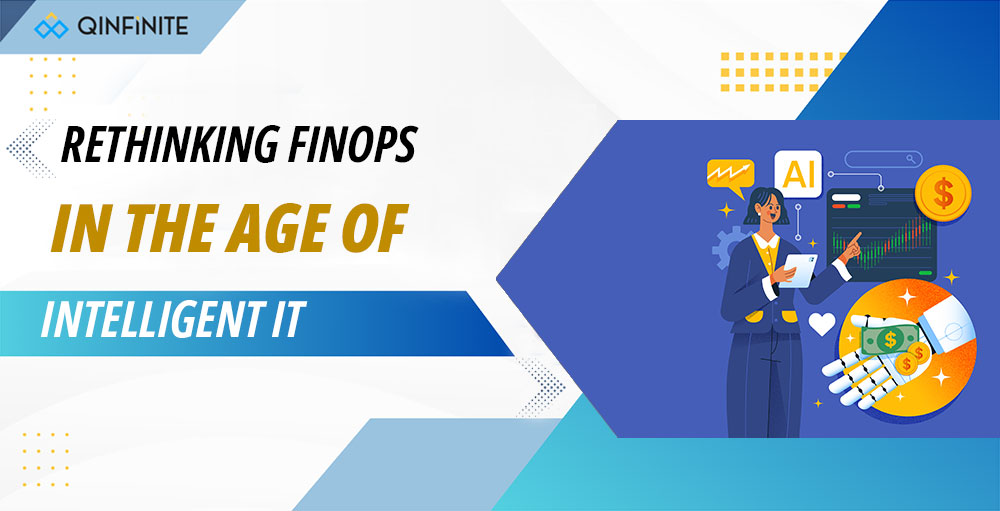
Why traditional FinOps approaches are no longer enough and what enterprises must do next.
Introduction – The Illusion of Control
Over the past decade, cloud adoption has fundamentally reshaped how enterprises build and scale technology. It promised flexibility, speed, and cost efficiency.
And for a while, it delivered.
But somewhere along the way, something changed.
Cloud environments became more complex. Architectures became more distributed. And costs once predictable, started behaving in ways that were harder to explain.
Today, most enterprises believe they have visibility into their cloud spend. Dashboards are in place. Reports are generated. Budgets are tracked.
But ask a simple question:
“What is actually driving our cloud costs?”
And the answer is rarely clear. This is the illusion of control.
The FinOps Promise and Its Limits
FinOps emerged as a response to this growing complexity. It brought structure, accountability, and financial discipline to cloud consumption.
It introduced:
- Cost allocation models
- Budget tracking mechanisms
- Usage visibility across teams
And it helped organizations take an important first step understanding where money is being spent.
But here’s the problem.
FinOps, in its current form, is largely built on billing data; and billing data tells you what you spent. It doesn’t tell you why you spent it.
The Real Problem: Lack of Context
Cloud cost is not just a financial problem.
It is a systems problem.
Every dollar spent in the cloud is tied to:
- An application
- A service
- A dependency
- A user interaction
- A business outcome
Yet most FinOps approaches operate in isolation from this context.
This leads to familiar challenges:
- Costs are analyzed without understanding system dependencies
- Optimization decisions are made without knowing downstream impact
- Engineering and finance teams operate with different views of reality
The result?
- Decisions that are technically correct but operationally risky.
- Savings that come at the cost of performance or reliability.
- Optimization efforts that don’t sustain over time.
Why Traditional Approaches Fall Short
Most FinOps tools struggle not because they lack features but because they lack contextual intelligence.
They:
- Aggregate cost data without mapping it to applications
- Provide insights after the fact (post billing cycle)
- Depend heavily on manual tagging and human interpretation
In modern environments where containers scale dynamically, microservices interact continuously and Infrastructure changes in real time – static, delayed, and fragmented views of cost are simply no longer enough.
The Shift: From Cost Visibility to Cost Intelligence
Enterprises are now realizing that visibility alone is not the end goal. What they need is understanding. This marks a critical shift:
This new model is not just about finance, it’s about bringing context into cost decisions.
What Intelligent FinOps Looks Like?
An intelligent approach to FinOps is built on a few foundational capabilities:
1. Continuous Discovery
A real-time understanding of all cloud resources, services, and dependencies.
2. Dependency Mapping
Visibility into how applications, services, and infrastructure interact—and how costs propagate across them.
3. Contextual Cost Attribution
Connecting cost to applications, business services, and outcomes—not just infrastructure.
4. Real-Time Insights
Moving from delayed billing reports to continuous cost intelligence.
5. Automated Optimization
Using AI-driven workflows to identify and act on cost inefficiencies proactively.
The Role of AI – Say Yes to Control and not Chaos!
AI is increasingly being introduced into FinOps, but in a somewhat hurried manner.
Enterprises must by now realize that blind automation can lead to:
- Unintended service disruptions
- Over-optimization
- Loss of control
The future lies in governed intelligence.
- Human-in-the-loop decision-making
- Policy-driven automation
- Context-aware actions
AI should not replace human judgment, it should augment it with better insights and faster execution.
Why This Matters Now
Cloud cost is no longer just an operational concern, it is a boardroom conversation.
CIOs, CFOs, and business leaders are asking:
- Are we spending efficiently?
- Can we predict and control our costs?
- Are our investments aligned with business outcomes?
Without context, these questions remain unanswered, and without answers, cost becomes a liability instead of a strategic lever.
The Qinfinite Perspective
At Qinfinite, we believe that FinOps must evolve beyond dashboards and reports.
It must become a living system of intelligence.
By combining:
- Continuous discovery
- Real-time dependency mapping
- Enterprise knowledge graph
- Agentic AI workflows
Qinfinite enables organizations to:
- Understand what drives cloud cost
- Identify inefficiencies in real time
- Optimize safely with context-aware automation
- Align cost with business value
This is not just better FinOps. This is Intelligent Cost Management for the modern enterprise.
What This Means for Enterprises
Enterprises don’t just need more visibility.
They need confidence:
- Confidence in their data
- Confidence in their decisions
- Confidence in their ability to scale without losing control
That confidence comes from context, and context is what transforms FinOps from a reactive function into a strategic capability.
Rethink how you manage cloud cost.
Move from visibility to intelligence with Qinfinite.