The Mystery No One Can Explain
Introduction
Every cloud journey reaches this point eventually where the dashboards are in place, the FinOps processes are running and the cost reports are reviewed regularly.
And yet…
There’s always that one question no one can confidently answer:
“Why did our cloud costs increase this month?”
Not just where the increase happened.
Not which service consumed more.
But why it happened?
Because more often than not, the answer isn’t obvious.
And that’s where the real problem begins.
The Surface-Level View of Cloud Cost
Most enterprises today rely on tools that show:
- Cost by service
- Cost by account
- Cost by region
- Cost trends over time
At first glance, this feels sufficient.
You can identify spikes, patterns and high-cost services, but this is only the surface. It tells you where money is being spent, not what’s actually driving it.
What You Don’t See Is What Costs You Most
Cloud environments today are deeply interconnected. A single application might depend on:
Multiple microservices
- APIs
- Databases
- Containers
- Background jobs
- Third-party integrations
Now imagine this scenario:
A backend service scales up due to increased API traffic, which triggers additional database usage, which in turn increases storage and compute costs and then goes on to impact another dependent service.
By the time you see the cost spike…The cause is already buried across multiple layers.
And your dashboard?
It simply shows:
- “Database cost increased”
- “Compute usage went up”
But it doesn’t tell you the following:
- What triggered it
- Which application caused it
- Whether it was necessary or wasteful
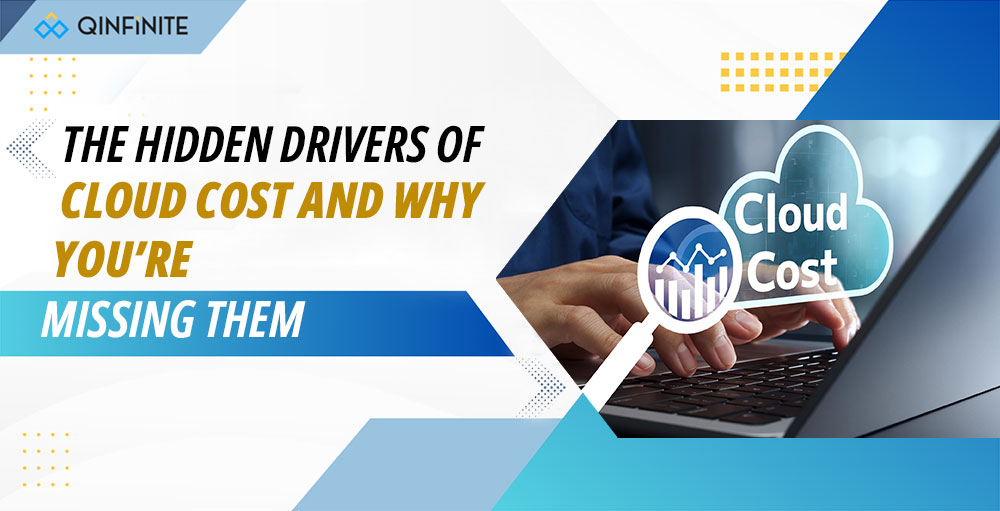
The Hidden Drivers of Cloud Cost
Let’s break this down.
In most enterprises, cloud cost is driven by factors that are not directly visible in billing data.
1. Application Behavior
Changes in traffic, user behavior, or releases can silently increase resource consumption.
2. Service Dependencies
One service scaling often triggers multiple downstream effects.
3. Architectural Decisions
Inefficient service design, over-engineering, or redundant components increase cost over time.
4. Idle and Orphaned Resources
Resources that are no longer in use but are still running while quietly accumulate cost.
5. Dynamic Environments
Containers, auto-scaling groups, and serverless workloads constantly change, making cost patterns unpredictable.
Why Traditional FinOps Misses This
The core issue is simple and that is FinOps operates on financial data, but cost is created by system behavior. This disconnect leads to blind spots because financial data:
- Is aggregated
- Lacks system-level relationships
- Comes with delay
Which means:
- You detect cost changes late
- You lack clarity on root causes
- You rely on manual investigation
And in fast-moving environments, by the time you understand the issue, it has already evolved.
The Cost of Not Knowing
This lack of visibility into true cost drivers has real consequences:
- Optimization becomes reactive
- Teams hesitate to make changes
- Engineering and finance remain misaligned
- Cost inefficiencies persist unnoticed
Worse, organizations often optimize the wrong things – cutting costs where it’s visible while ignoring where it’s actually driven.
A Different Way to Look at Cloud Cost
To truly understand cloud cost, you need to shift perspective.
Instead of asking:
“Which service is expensive?”
You need to ask:
“What system behavior is driving this cost?”
This requires:
- Mapping applications to infrastructure
- Understanding dependencies between services
- Tracking how changes propagate across systems
In other words, you simply need context.
From Cost Visibility to Cost Causality
This is where the real shift happens.
Traditional View:
- Cost is a number
- Optimization is reactive
- Decisions are isolated
Intelligent View:
- Cost is an outcome of system behavior
- Optimization is proactive
- Decisions are context-aware
This is the difference between seeing a problem and actually understanding it.
Where Qinfinite Changes the Game
This is exactly the gap Qinfinite is built to address.
By continuously discovering your environment and mapping dependencies across applications, services, and infrastructure…
Qinfinite helps you:
- Trace cost spikes back to their true source
- Understand how services influence each other
- Identify hidden inefficiencies in real time
- Optimize safely without unintended consequences
So instead of guessing, you operate with clarity.
A Simple Analogy
Think of cloud cost like electricity usage in a large building.
Traditional tools tell you that “Your electricity bill increased.”
But they don’t tell you:
- Which floor caused it
- Which equipment was responsible
- Whether it was necessary
Qinfinite, on the other hand, gives you a live map of the entire building with visibility into how everything is connected and the ability to pinpoint exactly what’s driving consumption
Conclusion – The Cost You Don’t See
Most enterprises are not overspending because they lack visibility. They’re overspending because they lack understanding. The real drivers of cloud cost are hidden:
- In dependencies
- In system behavior
- In architectural complexity
Until you uncover those drivers, cost optimization will always be incomplete; because you can’t optimize what you don’t understand.
CTA
Want to uncover what’s really driving your cloud cost?
Move beyond surface-level insights and gain true cost intelligence.