The moment of Realization
Introduction
It usually starts with a number. A cloud bill that’s higher than expected. A spike no one can explain. A finance review that turns uncomfortable.
At first, the response is predictable.
“We need better visibility.”
“Let’s implement FinOps.”
“Let’s track usage more closely.”
And so begins the journey.
Dashboards are built. Reports are generated. Teams are aligned around cost accountability.
For a while, things improve, but then, something strange happens. The visibility and the data is there and yet the questions remain.
Why are we spending this much?
What’s actually driving these costs?
And more importantly – what do we fix without breaking something else?
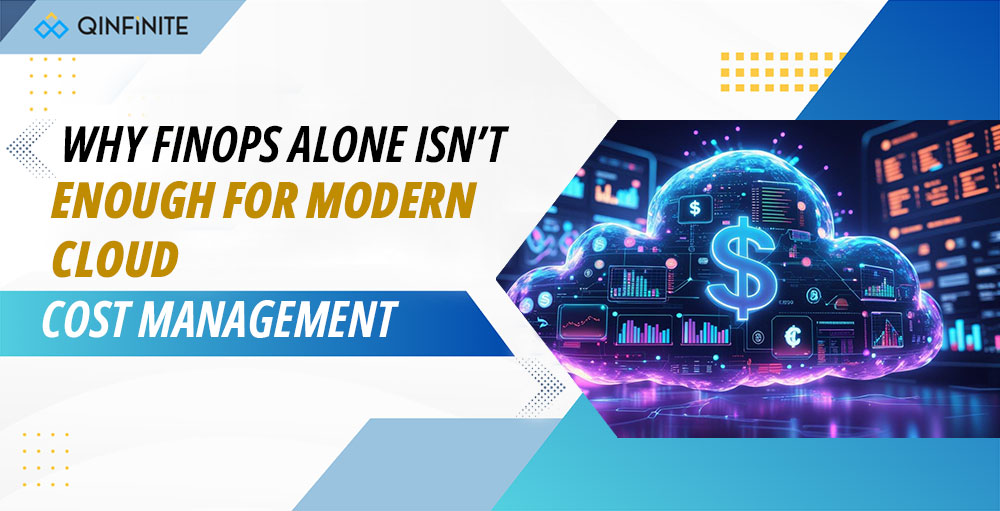
That’s when most enterprises realize FinOps helped them see the problem, but it didn’t help them truly understand it.
The Promise of FinOps
FinOps has played an important role in bringing financial discipline to cloud consumption.
It gave organizations:
- A shared language between finance and engineering
- Visibility into cloud usage and spend
- Mechanisms for budgeting and cost allocation
And for many enterprises, this was a much-needed step forward.
Because before FinOps, cloud spend was often… invisible.
Where FinOps Starts to Break Down
But modern cloud environments are not simple anymore.
They are:
- Highly distributed
- Continuously changing
- Deeply interconnected
Applications are no longer monolithic. They are built on layers of services, APIs, containers, and infrastructure. This is where FinOps begins to struggle, because most FinOps approaches are built on billing data.
And billing data, by design, is:
- Aggregated
- Delayed
- Devoid of operational context
It tells you what you spent.
But not:
- What caused it
- How systems interact
- Or what happens if you change something
The Hidden Gap: Cost Without Context
Imagine this scenario:
A service shows a sudden increase in cost. Your dashboard flags it.
Now what?
You can:
- Drill into usage
- Look at tags
- Analyze trends
But can you answer the below questions:
- Which application is driving this?
- What upstream or downstream services are involved?
- Whether reducing resources will impact performance elsewhere?
Most of the time, the answer is no.
Because cost is being analyzed in isolation and in modern IT environments, nothing exists in isolation.
Why This Matters More Than Ever
This gap between cost and context is not just a technical inconvenience.
It has real consequences:
- Optimization efforts become risky
- Teams hesitate to take action
- Savings opportunities are missed
- Costs creep back even after optimization
In some cases, organizations end up in a cycle where they are able to identify waste, attempt optimization, face unintended impact and are even able to roll back changes and yet the problem persists.
The Shift We Need to Make
To move forward, enterprises need to rethink a fundamental assumption that cloud cost is not just a financial metric. It is a reflection of how systems behave.
Which means managing cost requires understanding:
- Applications
- Dependencies
- Infrastructure relationships
- Real-time system behavior
This is where the shift happens from ‘Tracking spend’ to ‘understanding cost drivers’
From FinOps to Intelligent Cost Management
The next evolution of FinOps is not about more dashboards. It’s about contextual intelligence and ready to consume insights. This means:
- Knowing which services drive cost across an application
- Understanding how changes in one component impact others
- Seeing cost in real time and not after the billing cycle
- Acting on insights safely and confidently
And increasingly, it means introducing automation, not the blind type but automation that is intelligent and context-aware with human control built in.
Where Qinfinite Fits In (Naturally)
This is exactly where platforms like Qinfinite change the equation by combining:
- Continuous discovery
- Dependency mapping
- Real-time system intelligence
Qinfinite connects cloud cost to the actual structure of your enterprise systems.
So instead of asking:
“Where are we spending?”
You can finally answer:
“What is driving our spend—and what should we do about it?”
And more importantly you can act on those insights without guesswork.
A More Practical Way to Think About It
Think of it this way. Traditional FinOps gives you a financial report, but Intelligent cost management gives you a system-level understanding.
One tells you what happened while the other tells you why it happened and what to do next.
Conclusion – Seeing Is Not Understanding
FinOps was never the final destination. It was the first step, and for many enterprises, it solved a critical problem which was lack of visibility. But today, visibility is no longer enough because seeing your cloud cost doesn’t mean you understand it.
And without understanding, optimization will always be reactive, risky and incomplete. The future belongs to organizations that are able to move beyond visibility and start operating with context.
CTA
Ready to move beyond cost tracking?
Discover how intelligent cost management can transform your FinOps strategy.