And why this is crucial for the success of your enterprise modernization program.
Introduction – The Cost That Rarely Shows Up Clearly
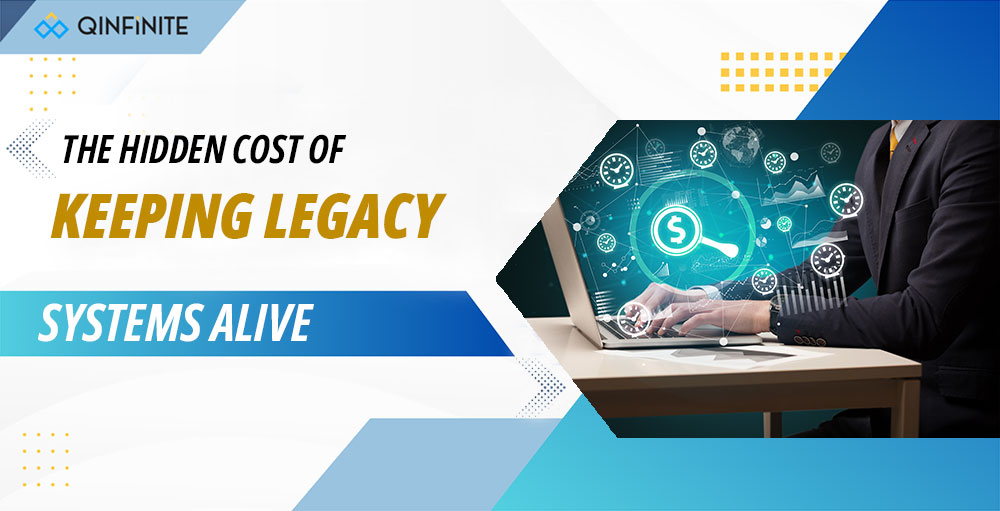
Most organizations can tell you how much they spend on cloud. Fewer can tell you how much they spend on legacy systems. And almost none can tell you the true cost of keeping them alive.
Because unlike cloud bills, legacy costs don’t always show up as a single number.
They are spread across:
- infrastructure
- maintenance
- support teams
- licensing
- operational overhead
Individually, they seem manageable, but collectively, they add up to something far more significant.
The Comfort of “It Still Works”
Legacy systems tend to stay for one simple reason and that is “They still work…don’t they and why fix when it ain’t broken”.
- They support critical processes.
- They’ve been around for years.
- People know how to use them.
So the logic becomes:
- “Let’s not disturb it.”
- “We’ll modernize it later.”
- “It’s too risky to change right now.”
And over time, “later” keeps getting pushed further away.
The Cost You See and the Cost You Don’t
When organizations evaluate legacy systems, they usually look at direct costs:
- infrastructure spend
- licensing fees
- basic maintenance
But these are just the visible layers. The real cost lies beneath. Let’s look at what these are:
1. Operational Overhead
Legacy systems often require:
- specialized skill sets
- manual processes
- constant monitoring
This increases dependency on a shrinking pool of expertise.
2. Inefficiency by Design
Older systems were not built for:
- scalability
- automation
- modern integration
Which means:
- more effort to achieve less
- slower response to business needs
3. Redundancy Across Systems
Over time, organizations accumulate:
- multiple systems doing similar things
- overlapping functionality
- duplicated data flows
And yet, all of them continue to run.
4. Opportunity Cost
This is the one that rarely gets measured.
Every dollar spent maintaining legacy systems is a dollar not invested in:
- innovation
- new capabilities
- business growth
5. Hidden Risk Exposure
Legacy systems often:
- lack proper documentation
- have unknown dependencies
- are difficult to secure
Which increases risk – especially during change.
Why This Problem Persists
If the cost is so significant, why do organizations keep these systems?
Because the alternative feels uncertain.
Modernization is seen as:
- complex
- risky
- resource-intensive
And without clear visibility into:
- what the system actually does
- who uses it
- how it connects to other systems
More often than not, doing nothing feels safer than doing something.
The Real Issue: Lack of Clarity
At its core, the problem is not legacy systems. It’s the lack of clarity around them.
Organizations struggle to answer these critical and valid questions:
- Is this system still being actively used?
- What business function does it support?
- Are there other systems doing the same job?
- What happens if we remove or replace it?
Without these answers, decisions get delayed while costs and complexity continue to increase.
When Maintenance Becomes a Strategy
Over time, something subtle happens. Maintenance stops being a temporary state and takes the shape of a strategy.
Teams spend more time:
- keeping systems running
- fixing issues
- managing dependencies
Than actually transforming them.
And the longer this continues the harder modernization becomes.
A Shift in Thinking
To address this, forward looking enterprises need to rethink how they view their legacy systems.
Instead of asking:
“How do we modernize this?”
They need to ask:
“Should this exist at all?”
This is where Application Portfolio Rationalization (APR) becomes critical.
From Preservation to Rationalization
APR shifts the conversation from preservation to purpose.
It helps organizations:
- identify redundant applications
- uncover low-value systems
- understand real usage patterns
- prioritize what truly matters
Because not every system deserves to be modernized.
Some should be:
- retained
- replaced
- consolidated
- or retired
Where Qinfinite Makes the Difference
This is where Qinfinite brings clarity. By continuously discovering applications and mapping their dependencies, Qinfinite helps you:
- understand which systems are actually used
- identify overlaps and redundancies
- connect applications to business functions
- evaluate impact before making decisions
So instead of operating in uncertainty, you gain a clear, data-driven view of your application landscape. And instead of carrying forward unnecessary cost, you eliminate it at the source.
A Simple Way to Look at It
Think of your IT landscape like a warehouse.
Over the years, things get added:
- tools
- systems
- processes
But rarely removed.
Eventually, you end up paying to store things you no longer use.
Legacy systems are no different.
The Bottom Line
The cost of legacy systems is not just what you spend to run them. It’s what you spend to keep them when you no longer need them.
In today’s enterprise, the question is not:
“How much do our legacy systems cost?”
It is:
“How much are we losing by keeping them?”
Ready to uncover the true cost of your legacy systems?
Discover how Qinfinite helps you identify, rationalize, and optimize your application landscape.