And why this needs immediate attention.
Introduction – The Cost You Don’t See on a Dashboard
Most enterprises today have a reasonable handle on their cloud spend.
They track:
- infrastructure costs
- platform usage
- billing trends
But there’s another category of spend that rarely gets the same attention.
- It doesn’t show up in one place.
- It isn’t owned by a single team.
- And it grows quietly over time.
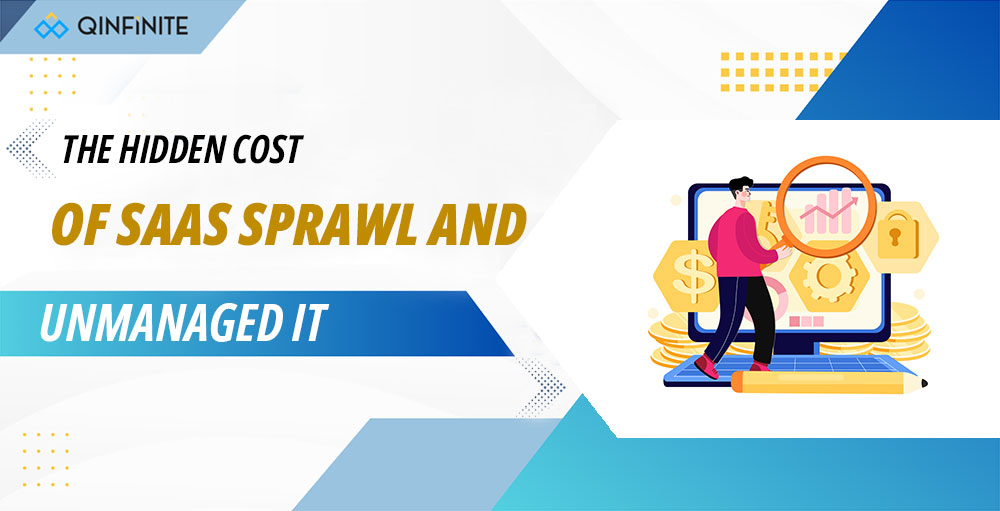
This is the hidden cost of SaaS sprawl and unmanaged IT. And for many organizations, this is where a significant portion of technology spend is hiding.
How It Starts (And Why It Feels Harmless)
It usually begins with good intent. Something that appears pretty harmless and unsuspecting like below:
- A team needs a tool to move faster.
- An individual signs up for a SaaS platform.
- A short-term solution becomes part of daily workflow.
And all this without the need of approvals, without delay and friction. In isolation, it feels efficient, but multiply that across teams, departments, and regions…and you get an ecosystem no one fully tracks.
The Growth of Invisible Spend
Unlike traditional IT procurement, SaaS adoption is:
- decentralized
- easy to access
- often outside formal processes
Which means:
- multiple teams may use similar tools
- subscriptions continue long after usage drops
- licenses are underutilized or forgotten
Over time, this creates a layer of spend that is real but not fully visible.
What does a SaaS Sprawl Actually Looks Like
It’s not always obvious.
It often shows up as:
- three different tools doing the same job
- premium subscriptions used by a handful of users
- inactive accounts still being billed
- tools integrated into workflows but never reviewed
And because these costs are spread across budgets, no single view captures the full picture.
The Cost Is More Than Just Money
SaaS sprawl doesn’t just impact budgets. It creates ripple effects across the organization which are visible as.
Financial Leakage
- Duplicate subscriptions
- Unused licenses
- Overlapping tools
Small inefficiencies that add up significantly.
Operational Complexity
- Multiple tools for similar functions
- Fragmented workflows
- Increased management overhead
More systems to manage, without added value.
Security & Compliance Risk
- Tools handling sensitive data outside governance
- Lack of visibility into access controls
- Difficulty in enforcing policies
What starts as convenience becomes exposure.
Lack of Accountability
When no one owns the full picture, no one is responsible for optimizing it.
Why Traditional Approaches Don’t Solve This
Most organizations try to control SaaS sprawl through:
- procurement policies
- expense audits
- periodic reviews
But these approaches have limits:
- They rely on declared usage
- They miss tools adopted outside formal channels
- They don’t capture real usage patterns
And most importantly they don’t connect tools to actual business value.
The Real Problem: Lack of Visibility and Context
At its core, SaaS sprawl exists because organizations lack:
A complete, real-time view of their environment – and even when tools are identified, there’s still a gap. Understanding how they are used and why they exist.
- Which teams rely on them?
- What processes depend on them?
- Are they redundant—or critical?
Without this context optimization becomes plain guesswork.
From SaaS Management to Cost Intelligence
To truly address this, organizations need to move beyond tracking subscriptions to understanding their role in the system
This means:
- discovering all SaaS and applications continuously
- mapping how they connect to workflows and systems
- identifying redundancy and underutilization
- aligning tools with business outcomes
Where Qinfinite Makes the Difference
This is where Qinfinite brings clarity. By continuously discovering SaaS applications and mapping their relationships, Qinfinite helps you:
- identify all tools across your enterprise—including shadow IT
- understand usage patterns and dependencies
- detect redundancy and inefficiencies
- connect cost to actual business usage
So instead of asking:
“What are we paying for?”
You can finally answer:
“What are we paying for, and do we actually need it?”
A Simple Analogy
Think of SaaS sprawl like subscriptions at home.
- A streaming service you forgot to cancel.
- A premium plan you no longer use.
- Multiple services offering similar content.
Individually, the cost feels small, but collectively, they become significant. Now imagine that at enterprise scale.
The Bottom Line
The cost of SaaS sprawl is not just what you spend. It’s what you spend without realizing it.
In today’s enterprise, the question is no longer:
“How much are we spending on SaaS?”
It is:
“How much are we spending on tools we don’t fully understand or even know exist?”
Ready to uncover hidden SaaS spend and eliminate inefficiencies?
Discover how Qinfinite helps you identify, understand, and optimize your SaaS and IT landscape.