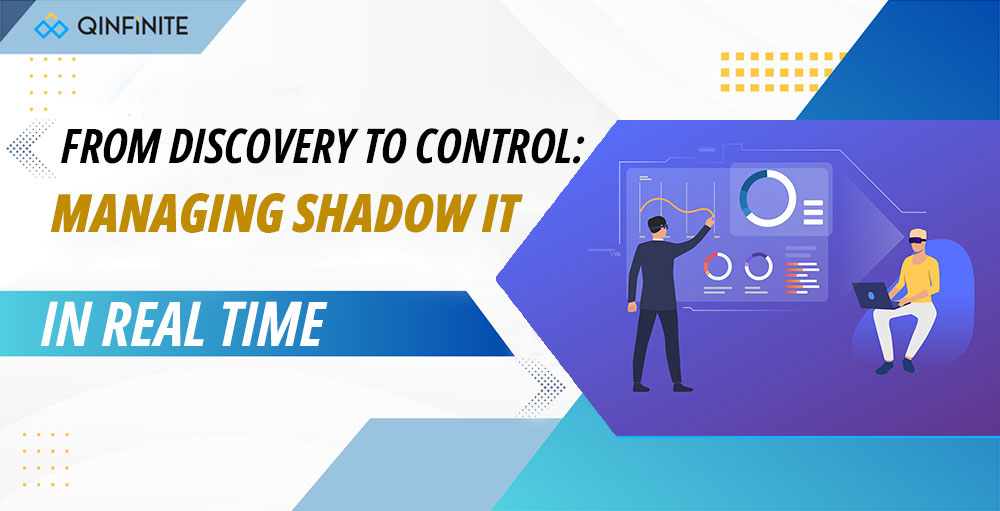
And why this matters!
Introduction – Discovery Is Just the Beginning
For most enterprises, the journey with Shadow IT starts with a realization that “We don’t know everything that exists in our environment.”
So the obvious next steps are:
- Discover what’s out there.
- Identify unknown applications.
- Uncover hidden SaaS tools.
- Map untracked infrastructure.
And for many organizations, this feels like progress. But after that initial discovery, a new question quickly emerges:
“Now that we know… what do we actually do about it?”
The Discovery Plateau
Much like other areas of IT, Shadow IT management often hits a plateau. Organizations invest in discovery tools and processes.
They generate:
- asset lists
- SaaS inventories
- reports of unknown systems
But over time, something becomes clear. Discovery alone doesn’t solve the problem.
And this is because:
- new systems keep appearing
- existing ones keep evolving
- risks change over time
And static lists quickly become outdated.
Why Discovery Without Action Falls Short
Knowing that something exists is useful.
But it doesn’t answer these questions:
- Is it risky?
- Is it redundant?
- Is it critical to operations?
- Should we allow it, govern it, or remove it?
Without these answers discovery creates awareness but not control. And awareness without action leads to delayed decisions, inconsistent responses and persistent risk.
The Real Challenge: Continuous Change
Modern IT environments are not static.
They are:
- constantly evolving
- driven by decentralized decisions
- shaped by real-time business needs
Which means Shadow IT is not a one-time problem, it is a continuous phenomenon where new tools are adopted, new integrations are created and new dependencies begin to emerge. And unless your approach evolves with it, you will always be catching up.
From Discovery to Understanding
The first shift is subtle but critical from “What exists?” to “What does it mean for my business?”
This requires context which comes from finding answers to these questions.
- What systems are connected?
- What data is being accessed?
- What business processes are involved?
Because not all shadow IT is equally risky. Some systems may be harmless or even valuable, while others may introduce serious vulnerabilities or create compliance issues. Without context everything looks the same and prioritization becomes impossible.
From Understanding to Control
Once you understand your environment, the next step is to move towards being able to exercise ‘Control’. Not in the sense of restricting everything.
But in the sense of:
- governing what is allowed
- managing what is necessary
- eliminating what is redundant or risky
This requires:
- clear policies
- consistent enforcement
- coordinated action across teams
And most importantly the ability to act in real time.
The Shift to Continuous Control
Traditional approaches operate in cycles:
- discover
- review
- act
But in dynamic environments, this isn’t enough.
The future lies in continuous control.
Where systems:
- detect new assets as they appear
- evaluate risk instantly
- apply policies automatically
- trigger actions when needed
This is not about reacting faster but about staying in control at all times.
The Role of AI – With Boundaries
As environments scale, manual control becomes difficult. This is where AI begins to play a role. But the goal is not blind automation. The goal is to achieve governed, context-aware intelligence across your enterprise.
Where:
- actions are based on system understanding
- policies guide decisions
- humans remain in control where it matters
This ensures consistency, safety and trust.
Where Qinfinite Fits In
This is exactly where Qinfinite enables the shift.
By combining:
- continuous discovery of unknown assets
- real-time dependency mapping
- contextual risk and cost intelligence
- and Agentic AI workflows
Qinfinite helps you move from:
discovery → understanding → control
So instead of:
- maintaining static inventories
- reacting to issues
- operating with uncertainty
You gain a continuously aware and controlled IT environment.
A Simple Way to Think About It
Imagine security cameras that only take a snapshot once a month.
You would:
- see what existed at that moment
- miss everything in between
Now imagine a live feed.
- continuous visibility
- real-time awareness
- immediate action when needed
That’s the difference between periodic discovery and continuous control.
The Maturity Shift
If you step back, the evolution becomes clear:
Unknown → Discovered → Understood → Controlled → Optimized
Most organizations today are between ‘Discovered and Understood’ and the logical next step for them would be is to move to ‘Control’. This is where real value begins.
The Bottom Line
Discovery is necessary, but it is not sufficient. In a world where IT environments change continuously, the goal is no longer:
“Do we know what exists?”
It is:
“Are we continuously in control of what exists?”
Ready to move from discovery to control?
Discover how Qinfinite helps you continuously identify, understand, and govern shadow IT in real time.