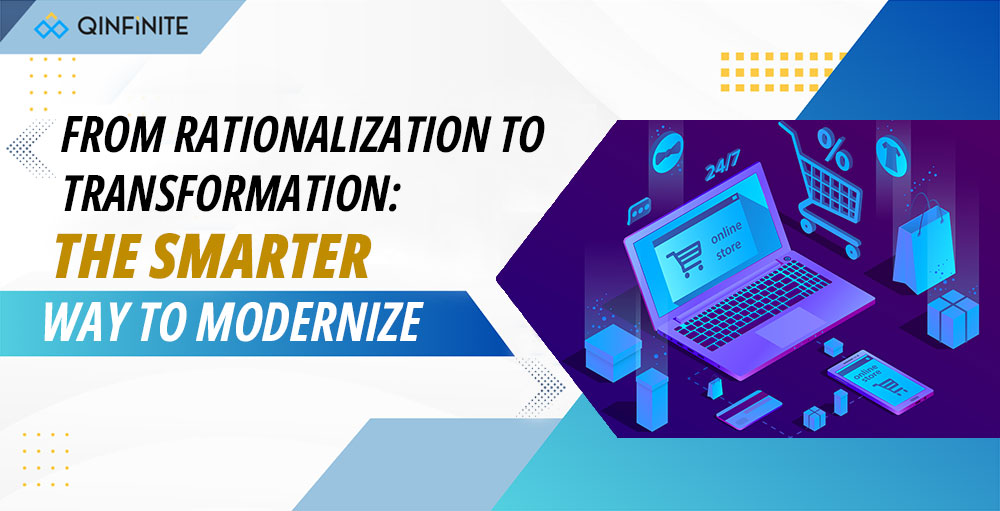
And why forward looking enterprises looking to modernize should try this to succeed.
Introduction – Why Modernization Alone Isn’t Enough
Most enterprises don’t lack modernization initiatives.
- They have roadmaps.
- They have programs.
- They have budgets allocated to transformation.
And yet, many of these efforts struggle to deliver meaningful outcomes.
Not because the intent is wrong, but because modernization often starts at the wrong place – with execution instead of understanding.
The Missing First Step
Modernization is often approached as a technical exercise:
- Moving applications to the cloud
- Replatforming systems
- Upgrading technology stacks
But this assumes something critical and that is – ‘everything currently in the landscape deserves to be modernized’.
And it must be noted that this assumption is rarely true most of the times. Most enterprise environments today contain:
- redundant applications
- underutilized systems
- outdated functionality
- overlapping capabilities
So when modernization begins without addressing this, the current inefficiencies along with their hidden risks and complexity are simply carried forward into a new environment.
Why Rationalization Changes Everything
This is where the shift begins.
From:
“How do we modernize our systems?”
To:
“What should we modernize and what should we not?”
This is the essence of Application Portfolio Rationalization (APR).
APR brings clarity by helping organizations:
- identify what is actually in use
- understand business relevance
- uncover redundancy
- eliminate low-value systems
It simplifies the landscape before transformation begins.
From Complexity to Clarity
Once rationalization is in place, something important happens. The modernization problem becomes simpler. Instead of dealing with hundreds of applications, you focus on:
- the ones that matter
- the ones that deliver value
- the ones that need to evolve
This not only helps in creating clear priorities and reduced risk but also accelerates effective execution of your modernization program. This is because now you’re no longer trying to modernize everything, instead you are modernizing what matters.
The Role of Context in Modernization
Even after rationalization, one challenge remains and that is about understanding how systems are connected. Applications don’t operate in isolation.
They depend on:
- other applications
- shared infrastructure
- data flows
- business processes
Without this context:
- changes can have unintended consequences
- dependencies can break unexpectedly
- teams become hesitant to act
This is why modernization requires more than visibility. It requires system-level understanding.
From Rationalization to Intelligent Transformation
When you combine rationalization, dependency mapping and business context, your modernization efforts begin to evolve into ‘Intelligent Transformation’.
This is where your decisions now are:
- data-driven
- context-aware
- aligned with business outcomes
Instead of migrating blindly and prioritizing subjectively, your enterprise now operates with clarity and confidence.
Why Traditional Approaches Fall Short
Most modernization strategies today still rely on:
- static assessments
- manual analysis
- stakeholder assumptions
These approaches take time, become outdated quickly and miss hidden dependencies. And in fast-changing environments static decisions don’t hold true for long.
The Shift to Continuous Intelligence
Modernization is no longer a one-time initiative. It is an ongoing process.
As systems evolve:
- new applications are introduced
- usage patterns change
- dependencies shift
This requires a model that is continuous, not periodic and dynamic, not static, where insights are always up to date.
The Role of AI – With Control and Context
AI is increasingly being introduced into modernization efforts. But without context, it can lead to:
- incorrect recommendations
- unintended system impact
- lack of trust
The real value comes from context-aware, governed AI.
Where:
- recommendations are based on system relationships
- actions follow defined policies
- humans remain in control
Where Qinfinite Fits In
This is where Qinfinite iAM enables the shift.
By combining:
- continuous discovery of applications
- real-time dependency mapping
- application portfolio intelligence (APR)
- and Agentic AI workflows
Qinfinite helps organizations:
- understand their application landscape
- identify what to modernize, retain, or retire
- prioritize transformation based on business value
- act with confidence and control
So modernization becomes not just faster but safer and smarter.
A Simple Way to Think About It
Traditional modernization is like renovating a building room by room, without knowing the full layout.
Intelligent modernization is like having a complete blueprint:
- you know what exists
- you know what’s connected
- you know what matters
And you make decisions accordingly.
The Maturity Shift
If you step back, the evolution becomes clear:
Inventory → Visibility → Rationalization → Intelligence → Transformation
Most organizations today are somewhere between ‘Visibility and Rationalization’.
The next obvious step is to have ‘Intelligence’ to be able to truly transform your enterprise.
The Bottom Line
Modernization is not just about upgrading systems. It’s about making the right decisions before you begin.
In a world of increasing complexity, the goal is no longer:
“How fast can we modernize?”
It is:
“How intelligently can we transform?”
Ready to move from modernization to intelligent transformation?
Discover how Qinfinite helps you rationalize, prioritize, and modernize with confidence.