And why this matters.
The illusion of Visibility
Most enterprises believe they have a reasonable understanding of their IT environment.
They have:
- CMDBs
- Asset inventories
- Security tools
- Monitoring systems
On paper, everything appears accounted for.
But ask a simple question:
“Do we really know everything that exists in our environment?”
And the answer is rarely a confident yes.
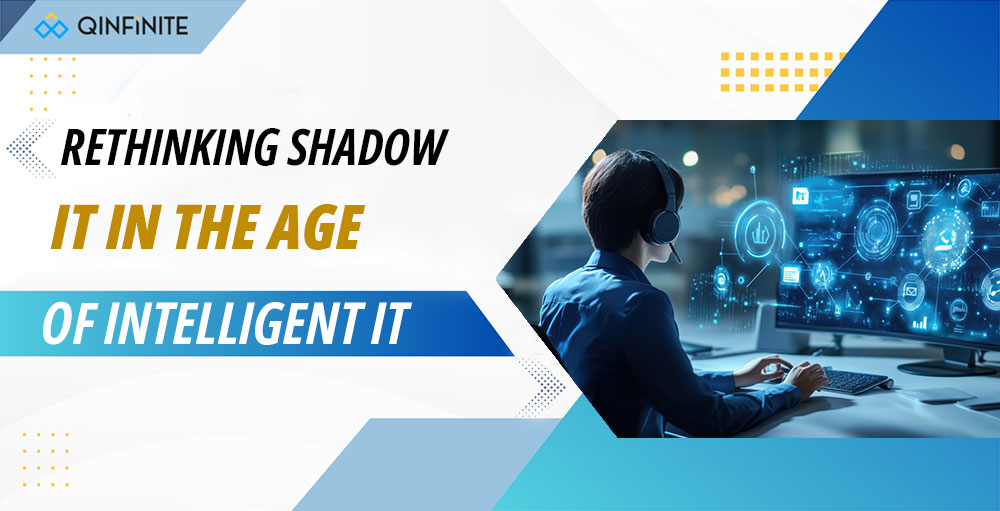
Because the reality is that a significant portion of enterprise IT operates outside formal visibility. This is what we call Shadow IT.
What Shadow IT Really Means Today
Traditionally, Shadow IT referred to unauthorized applications used by employees without IT approval. But today, the definition has expanded significantly.
Shadow IT now includes:
- Unapproved SaaS applications
- Unknown cloud resources
- Orphaned infrastructure
- Untracked APIs and integrations
- Legacy systems that no one owns but still run
It is no longer an exception. It is an inherent part of modern enterprise IT.
Why Shadow IT Is Growing – Not Shrinking
Despite increased governance and security investments, Shadow IT continues to grow.
Why? – Because modern IT environments are:
Decentralized
Teams adopt tools independently to move faster.
Dynamic
Cloud resources are created and destroyed continuously.
Accessible
Anyone can provision services without going through central IT.
Complex
Dependencies between systems are no longer fully visible.
The result? – IT environments evolve faster than they can be tracked.
The Real Problem: Unknown Risk
Shadow IT is often framed as a compliance or security issue. But the real problem runs deeper. It creates unknown risk.
Not just known vulnerabilities, but risks you don’t even know exist.
These include:
- Unsecured access points
- Data exposure through unmanaged tools
- Hidden dependencies that break during incidents
- Systems that bypass governance controls
And the most dangerous part is that you cannot mitigate what you don’t know.
The Cost You’re Not Tracking
Shadow IT is not just a security issue, it’s also a financial one. Unmanaged SaaS usage and redundant tools lead to:
- duplicate subscriptions
- underutilized licenses
- overlapping capabilities
These costs rarely show up clearly as they are distributed across teams, budgets and departments and over time they quietly accumulate into significant spend.
Why Traditional Approaches Fall Short
Most organizations try to address Shadow IT using:
- periodic audits
- manual discovery
- security tools focused on known assets
But these approaches have limitations:
- They rely on static data
- They miss dynamic changes
- They don’t capture relationships between systems
- They detect issues after they occur
In fast-moving environments static visibility quickly becomes outdated and can jeopardise your enterprise transformation initiatives.
The Missing Link: Context
Discovering Shadow IT is only the first step. Understanding it is what truly matters. Because an unknown system is not inherently risky.
Its risk depends on context.
- What data does it access?
- What systems does it connect to?
- What business processes depend on it?
Without this context:
- prioritization becomes guesswork
- remediation becomes risky
- decisions become delayed
From Discovery to Intelligence
To effectively manage Shadow IT, enterprises need to evolve their approach.
From:
This shift transforms Shadow IT from becoming an invisible threat into something that is a manageable, understood part of the system.
The Role of AI – With Governance
As environments scale, manual management of Shadow IT becomes impossible. AI can help, but only if applied responsibly. The future lies in:
Context-aware, governed AI
- Identifying unknown assets in real time
- Correlating them with system behavior
- Prioritizing risks based on impact
- Triggering policy-driven actions
With human-in-the-loop control and clear governance boundaries.
The Qinfinite Perspective
At Qinfinite, we believe Shadow IT is not just a discovery problem. It is a system intelligence problem. Through its Intelligent Application Management (iAM) platform, Qinfinite enables enterprises to:
- continuously discover unknown applications and assets
- map dependencies across systems and services
- understand risk in real time
- correlate cost, usage, and security context
- automate governance through Agentic AI workflows
This transforms Shadow IT from being ‘invisible to visible’, ‘visible to something that can be understood’ and from ‘something that can be understood to something that can be controlled’.
What This Means for Enterprises
Organizations that adopt this approach can:
- eliminate blind spots across their IT landscape
- reduce security and compliance risks
- control SaaS and cloud sprawl
- improve operational stability
- make faster, more confident decisions
Most importantly they regain control over what was previously unknown.
The Bottom Line
Shadow IT is not going away. It is a natural outcome of modern, decentralized, and dynamic IT environments.
The goal is not to eliminate it completely. The goal is to understand and control it intelligently.
In today’s enterprise, the biggest risks are not always the ones you can see. They are usually the ones you cannot.
Because the real question is no longer:
“Is our environment secure?”
It is:
“Do we truly know what exists in our environment?”
Ready to uncover what you don’t know?
Discover how Qinfinite helps you identify, understand, and control shadow IT across your enterprise.