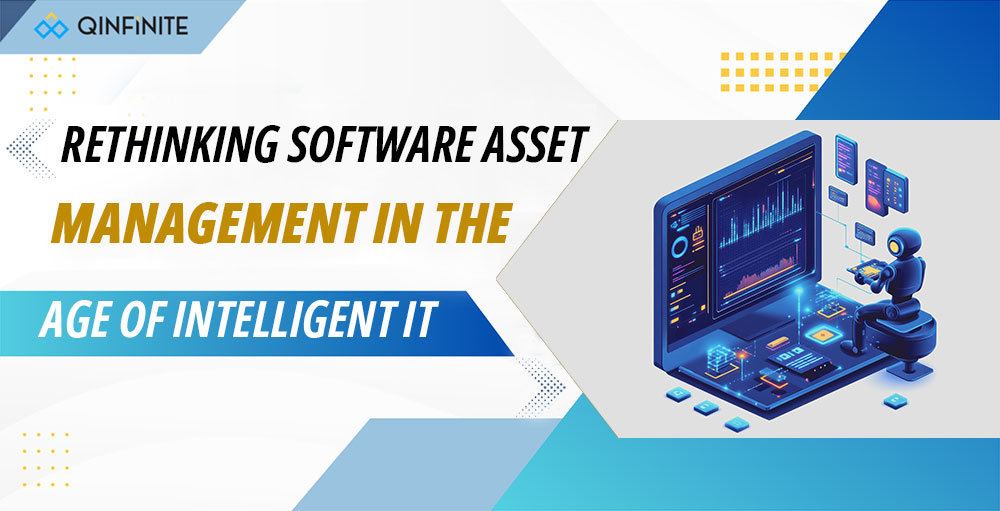
Why traditional SAM approaches are no longer enough and what enterprises must do next.
A Familiar Story in Enterprise IT
If you speak to most IT or finance leaders today, you’ll hear a similar pattern.
“We have a SAM tool.”
“We track licenses.”
“We prepare for audits.”
And yet, when the conversation goes deeper, a different reality emerges:
- Software costs continue to rise
- Audits remain stressful and reactive
- Teams still rely on spreadsheets and manual reconciliation
- No one is fully confident in the data
And eventually, someone asks the uncomfortable question:
“Do we actually know what we’re using—and what we’re wasting?”
That’s where traditional Software Asset Management begins to show its limits.
The Illusion of Control
For years, SAM has been treated as a control function that
- Track assets
- Maintain records
- Ensure compliance
On paper, this creates a sense of order. But in practice, most SAM programs are built on:
- incomplete discovery
- static inventories
- delayed updates
- disconnected systems
Traditional tools typically capture only 60–70% of the actual software estate.
The rest? Well that’s hidden across:
- SaaS applications
- shadow IT
- cloud-native environments
- containers and ephemeral workloads
What looks like control is often just partial visibility.
The Hidden Cost of Incomplete Visibility
This gap has real consequences.
Not just for IT, but also for the business.
- Software Waste
Unused and underutilized licenses continue to consume budgets silently. - Compliance Risk
Incomplete or inaccurate data creates exposure during vendor audits. - Inefficient Procurement
Renewals and negotiations are based on assumptions—not actual usage. - Operational Overhead
Teams spend weeks reconciling data across tools, often manually.
Most organizations don’t lack data. They lack confidence in that data.
The World Has Changed. SAM Hasn’t.
Modern IT environments are fundamentally different from when SAM tools were first designed.
Today’s enterprise is:
- hybrid (cloud + on-prem)
- distributed
- dynamic
- constantly evolving
Applications scale up and down while workloads move across environments and new tools are adopted faster than they can be tracked. In this world a static inventory is outdated the moment it is created.
The Core Problem: Lack of Context
Even when visibility improves, another challenge remains and that is understanding what that data actually means.
Traditional SAM answers:
- What software do we have?
- How many licenses are deployed?
But it struggles to answer:
- Who is actually using it?
- How often is it used?
- What business function does it support?
- What happens if we remove or reduce it?
Without this context:
- Optimization becomes guesswork
- Compliance becomes reactive
- Decisions become risky
A Shift in Thinking: From Assets to Intelligence
Leading enterprises are beginning to rethink SAM, not as a tracking function, but as an intelligence layer.
This shift is subtle, but powerful:
Asset Tracking → Usage Intelligence → Business-Aware Optimization
Instead of asking:
“What licenses do we own?”
They are asking:
“What should we keep, optimize, or eliminate, based on actual usage and business impact?”
What Modern SAM Must Look Like
To support this shift, SAM needs to evolve across three dimensions:
1. Continuous Discovery (Not Periodic Scans)
Software assets must be discovered continuously across environments—cloud, on-prem, SaaS, and containers.
2. Contextual Understanding (Not Just Inventory)
Software must be connected to:
- users
- applications
- infrastructure
- business services
So decisions are made with full context.
3. Intelligent Action (Not Manual Effort)
Insights must translate into action:
- reclaim unused licenses
- reallocate resources
- optimize renewals
- enforce compliance policies
Together, these capabilities transform SAM from a passive system into an active optimization engine.
The Role of the Enterprise Knowledge Graph
At the center of this transformation is a new foundation: The Live Enterprise Knowledge Graph
It connects:
- software assets
- usage patterns
- infrastructure dependencies
- business services
Into a single, continuously updated model.
This enables enterprises to move from:
fragmented data → connected intelligence
And from:
isolated decisions → system-wide optimization
From Insight to Autonomous Optimization
Even with better visibility and context, one challenge remains and that is acting on insights – quickly and consistently.
Most organizations still rely on:
- manual analysis
- delayed decision-making
- inconsistent execution
This is where the next evolution of Agentic AI begins.
AI agents that:
- analyze usage patterns
- identify optimization opportunities
- execute actions across systems
All within defined governance boundaries.
This creates a closed-loop system:
Discover → Understand → Decide → Act → Optimize
The Qinfinite Perspective
At Qinfinite, we believe Software Asset Management must evolve beyond tracking and reporting.
Through its Intelligent Application Management (iAM) platform, Qinfinite brings together:
- continuous Auto-Discovery
- a Live Enterprise Knowledge Graph
- Agentic AI workflows
To create a system that:
- understands software usage in real time
- connects it to business context
- continuously optimizes cost, compliance, and risk
What This Means for Enterprises
Organizations adopting this approach are seeing:
- up to 30–40% reduction in software costs
- significantly improved compliance readiness
- reduced manual effort across SAM operations
- better alignment between IT, finance, and procurement
But more importantly they are moving from reactive SAM → intelligent software optimization
The Bottom Line
Software Asset Management is no longer just about managing licenses.
It is about:
- understanding usage
- aligning with business value
- making intelligent decisions
- acting continuously
Closing Thought
In an era of intelligent IT, the question is no longer:
“Do we have visibility into our software assets?”
It is:
“Do we truly understand how software is used and are we acting on that insight?”
Ready to rethink Software Asset Management
Discover how Qinfinite enables intelligent, context-driven software optimization across your enterprise.