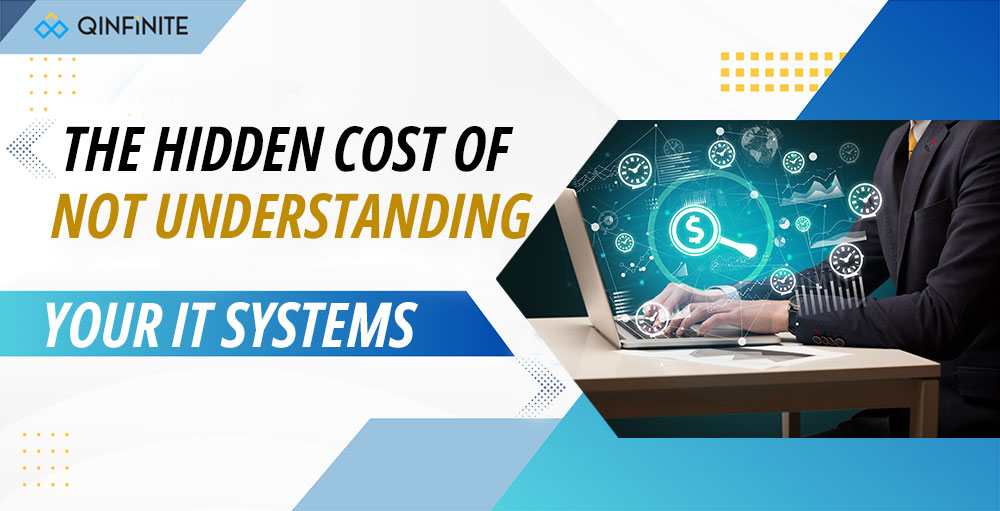
Why what you don’t see in your IT environment is quietly costing you more than you think
The Cost You Don’t See
Most enterprises track IT costs closely. Cloud bills are monitored. Budgets are reviewed. Vendor contracts are negotiated. On the surface, everything seems under control. But beneath these numbers lies a deeper issue, one that rarely shows up clearly in reports. Let us understand that by asking this simple question.
Do you truly understand how your IT systems work together?
Because if the answer is no, then there’s a good chance:
You’re spending more than you should.
Where the Money Actually Goes
IT costs don’t just come from infrastructure or licenses.
They come from inefficiencies hidden inside your systems.
And these inefficiencies often go unnoticed because they are not obvious.
They show up as:
- Overprovisioned resources that no one realizes are unused
- Duplicate tools solving the same problem in different silos
- Incidents that take hours longer to resolve than they should
- Teams working around systems instead of with them
Individually, these seem like small issues.
But at enterprise scale, they compound into significant financial impact.
The Visibility–Cost Disconnect
Most organizations approach cost optimization from a financial lens:
- reduce cloud spend
- renegotiate vendors
- eliminate unused licenses
But cost optimization without system understanding is incomplete.
Because cost is not just about what you spend. It’s about why you’re spending it.
And that “why” lives inside your systems, in how they are connected, used, and dependent on each other.
A Simple Example
Imagine an application running in your environment.
You see:
- high infrastructure usage
- increased cloud costs
So you try to optimize it.
But what you don’t see is:
- the application is supporting multiple dependent services
- one of those services is inefficient
- another is triggering unnecessary workloads
Without understanding these relationships, you optimize in isolation
and the real cost drivers remain untouched.
The Real Problem: Lack of System Understanding
At its core, the issue is not cost. It’s lack of context.
Most enterprises lack:
- clear visibility into system dependencies
- understanding of how applications interact
- insight into how infrastructure is actually being used
As a result:
- optimization efforts are reactive
- decisions are based on incomplete data
- inefficiencies persist
From Cost Tracking to Cost Intelligence
To truly control IT costs, organizations need to move beyond tracking spend. They need to build cost intelligence.
This means understanding:
- which systems drive costs
- how dependencies impact resource usage
- where inefficiencies originate
- how changes in one system affect others
Cost intelligence is not a finance problem. It is a system intelligence problem.
Why Dependency Mapping Matters
In modern IT environments, everything is connected. Applications rely on services. Services rely on infrastructure. Infrastructure scales dynamically.
Without understanding these dependencies:
- cost drivers remain hidden
- optimization efforts are misdirected
- risk increases
Dependency mapping brings clarity by showing:
- how systems interact
- where resources are consumed
- what truly drives cost
How Leading Enterprises Are Rethinking This
Forward-looking organizations are shifting their approach.
Instead of asking:
“How do we reduce cost?”
They are asking:
“Do we understand what is driving our cost?”
This shift leads to:
- better resource allocation
- smarter optimization decisions
- improved alignment between IT and business
The Role of Contextual Intelligence
To achieve this, enterprises need more than visibility. They need contextual intelligence. This is where a Live Enterprise Knowledge Graph becomes critical.
By connecting systems, dependencies, and usage patterns, it provides:
- a real-time view of how systems operate
- deeper insight into cost drivers
- the ability to identify inefficiencies accurately
The Qinfinite Perspective
At Qinfinite, we see cost optimization as an outcome of better system understanding.
Through its Live Enterprise Knowledge Graph, Qinfinite enables organizations to:
- map dependencies across applications and infrastructure
- understand how systems consume resources
- identify hidden inefficiencies
- align IT operations with financial outcomes
This transforms cost management from reactive tracking to proactive intelligence.
The Impact
Organizations that adopt this approach can achieve:
- Up to 60% reduction in operational costs
- improved resource utilization
- faster and more accurate decision-making
But more importantly:
They gain control over why costs exist — not just what they are.
The Bottom Line
Most enterprises are not overspending because of poor budgeting. They are overspending because of incomplete system understanding. And until that changes, cost optimization will always be limited.
Remember! You can’t optimize what you don’t understand.
And in modern IT: Understanding your systems is the first step to controlling your costs.