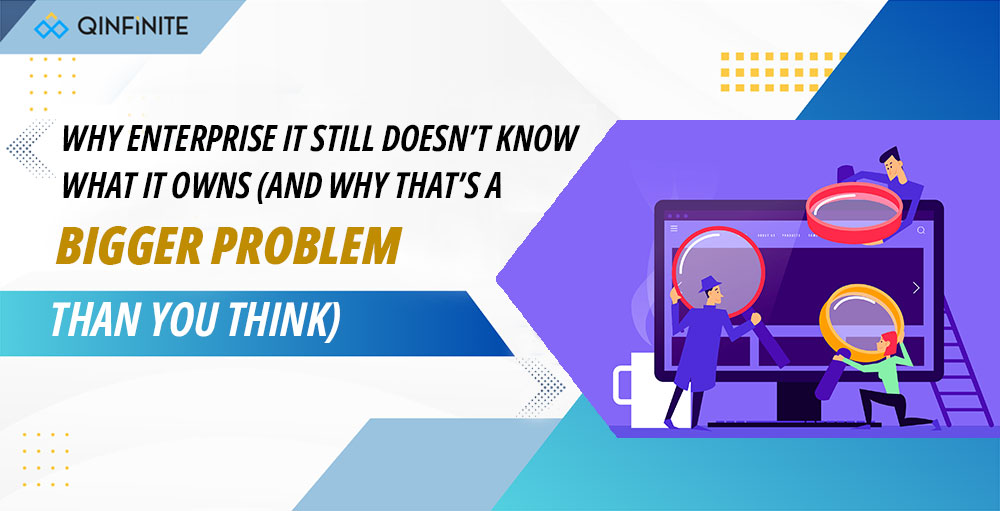
Most enterprises believe they have visibility into their IT landscape. The reality is very different. They have configuration management databases (CMDBs). Monitoring tools. Dashboards. Reporting tools etc.
And yet, if you ask a simple question –
“What exactly is running in your environment right now?”
Very few organizations can answer with confidence.
The Illusion of Visibility
Modern enterprise IT is no longer a static environment. It is dynamic, distributed, and constantly evolving.
- Cloud resources spin up and down in minutes
- APIs connect dozens of internal and external systems
- Microservices create complex, interdependent architectures
- Shadow IT emerges outside centralized governance
In this environment, traditional approaches to visibility fall short.
Most organizations are operating with:
- Incomplete system visibility
- Outdated configuration data
- Disconnected operational tools
What looks like visibility is often just an illusion of control.
Why This Is a Bigger Problem Than It Seems
Lack of visibility is not just a technical issue, it’s a business risk.
When enterprises don’t fully understand their systems:
- Incidents take longer to resolve
- Root causes remain unclear
- Costs increase due to inefficiencies
- Security risks go undetected
- Business processes get disrupted
And most importantly:
Decisions are made based on incomplete or inaccurate data
The Shift from Static to Continuous Discovery
Traditional discovery methods were designed for stable environments.
They rely on:
- periodic scans
- manual updates
- static system records
But modern IT doesn’t sit still.
To keep up, organizations need continuous discovery; a model where systems, applications, and dependencies are:
- automatically detected
- continuously updated
- dynamically mapped
Instead of static inventories, enterprises gain a living view of their IT ecosystem.
From Visibility to System Intelligence
True visibility is not just about knowing what exists. It’s about understanding:
- how systems are connected
- how they behave
- how failures propagate
This is where discovery evolves into system intelligence. When discovery data is enriched and contextualized, it becomes the foundation for:
- faster incident resolution
- better decision-making
- proactive operations
Where Qinfinite Comes In
Qinfinite’s Auto-Discovery Engine is designed for modern enterprise complexity.
It continuously discovers infrastructure, applications, and services across hybrid environments — building a real-time map of your IT ecosystem.
But more importantly, it doesn’t stop at discovery.
By feeding this data into a live Enterprise Knowledge Graph, Qinfinite enables organizations to understand relationships, dependencies, and system behavior at scale.
This transforms visibility into actionable intelligence.
The Bottom Line
Most enterprises don’t lack tools. They lack true visibility. And without it, everything else automation, AI, optimization etc. falls short. The organizations that will lead in the next era of IT are not the ones with the most tools. They are the ones that finally answer the question: ”Do we really know what we own?”