Introduction – The Pattern No One Talks About
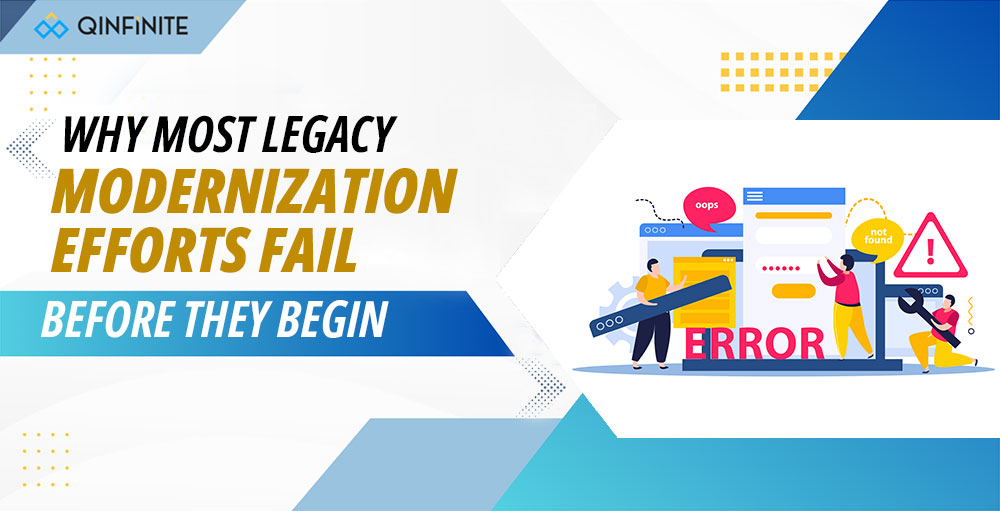
Most legacy modernization programs don’t fail loudly. Neither do they collapse overnight.
They don’t trigger immediate alarm bells but instead, they drift, and this drift is visible in the form of ‘timelines stretch’, ‘costs increase’ and ‘ever changing scope’.
And somewhere along the way, the original intent for the modernization program gets lost. What started as a strategic transformation becomes a long-running initiative that never quite delivers what it promised.
If you’ve been part of one, you’ve probably seen it. And if you look closely, the problem often starts much earlier than expected.
It’s Not an Execution Problem
When modernization struggles, the first instinct is to question execution.
- Was the plan flawed?
- Did the teams lack capability?
- Were the tools insufficient?
But in most cases, execution is not the root cause. The real issue is more fundamental and often overlooked. The problem starts before execution even begins.
The First Decision Is the Most Important One
Every modernization journey begins with a set of decisions.
- Which applications should we modernize?
- Which ones should we move to the cloud?
- Which systems should we replace or retire?
These decisions shape everything that follows.
And yet, they are often made based on:
- outdated inventories
- incomplete data
- stakeholder assumptions
- or simply urgency to “move forward”
At that point, the trajectory is already set. If the decisions are wrong, the outcomes will be too.
Modernizing Without Understanding
One of the most common patterns in enterprises is this:
Applications are modernized without a clear understanding of:
- how they are actually used
- what business value they deliver
- how they connect to other systems
So what happens?
- Low-value applications get migrated
- Redundant systems are carried forward
- Critical dependencies surface too late
And organizations end up investing time and money into systems that shouldn’t have been modernized in the first place.
The Hidden Complexity of Legacy Environments
Legacy environments don’t just consist of old systems.
They consist of:
- years of accumulated decisions
- undocumented dependencies
- overlapping functionalities
- fragmented ownership across teams
What looks like a single application is often part of a much larger web. And that web is rarely visible upfront. So when modernization begins without understanding this complexity the risk isn’t just inefficiency and takes the shape of an unintended disruption
Why “Lift and Shift” Isn’t a Strategy
Faced with complexity, many organizations take the safest-seeming route which is ‘Move everything as-is.’ also popularly known as ‘Lift and shift’.
At first, this feels like progress. But in reality, it often leads to:
- higher cloud costs
- continued inefficiencies
- increased operational complexity
Because instead of solving the problem, it simply moves it to a new environment. We must note here that ‘legacy doesn’t disappear’, It just changes location and so does the complexity and risk that come with it.
The Cost of Getting It Wrong
When modernization starts with the wrong assumptions, the impact compounds over time:
- budgets increase without proportional value
- timelines extend due to unexpected dependencies
- teams spend time fixing issues instead of driving transformation
- business confidence in modernization efforts declines
And perhaps most importantly opportunities to simplify and optimize are missed.
What Successful Modernization Looks Like
If you look at organizations that get modernization right, there’s a clear difference. They don’t start with execution, instead they start with understanding.
They ask these questions:
- Which applications truly matter to the business?
- Which ones are redundant or obsolete?
- How are systems connected?
- What is the risk of change?
Only after answering these questions do they move forward.
From Modernization to Rationalization
This is where the conversation shifts.
From:
“How do we modernize everything?”
To:
“What should we modernize and what should we not?”
This is the essence of Application Portfolio Rationalization (APR).
It allows organizations to:
- eliminate unnecessary complexity
- focus investment where it matters
- reduce cost before transformation begins
Because sometimes, the best modernization decision is not to modernize at all.
A Different Way to Think About It
Think of modernization like renovating a building.
You wouldn’t:
- renovate every room blindly
- invest in areas no one uses
- ignore structural dependencies
You would first:
- understand the layout
- identify what’s critical
- decide what to keep, change, or remove
Modernization is no different.
Where Qinfinite Fits In
This is exactly the gap Qinfinite intelligent application management platform (iAM) addresses.
By continuously discovering your application landscape and mapping dependencies,
Qinfinite helps you:
- understand how systems are connected
- identify redundant and low-value applications
- evaluate business impact before making changes
- prioritize modernization with clarity
So instead of starting with assumptions, you start with insight. And instead of reacting to problems, you prevent them upfront.
The Bottom Line
Most modernization efforts don’t fail during execution. They fail because of the decisions made at the beginning.
In today’s complex IT environments, the real challenge is no longer:
“How do we modernize?”
It is and will remain:
“Are we modernizing the right things?”
Ready to modernize with clarity instead of guesswork?
Discover how Qinfinite helps you make smarter modernization decisions from day one.