Executive Summary
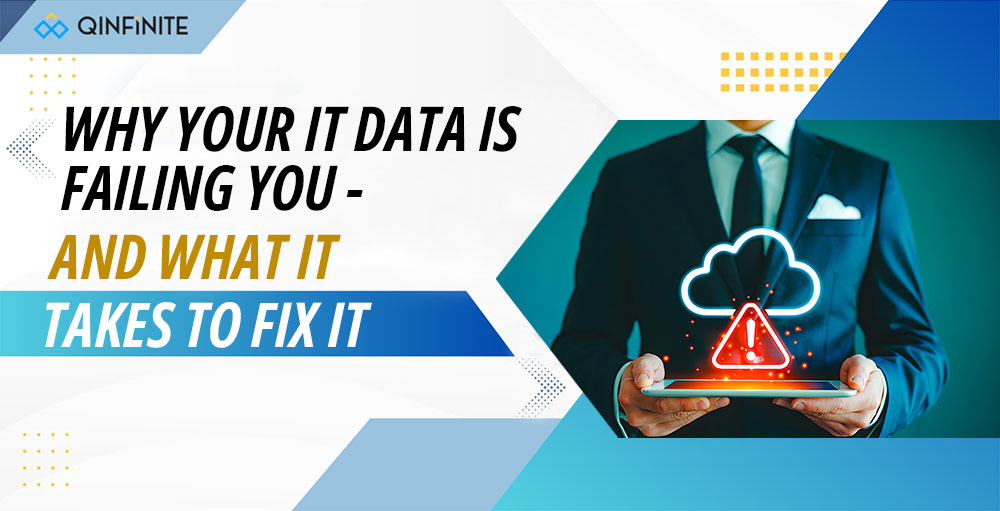
Enterprise IT has never had more data.
From infrastructure metrics and application logs to monitoring alerts and business events, organizations today generate vast amounts of operational data across their technology landscape.
And yet, many enterprises still struggle to answer fundamental questions:
- What systems are running right now?
- How are they connected?
- What is the real impact of an issue?
The challenge is not the absence of data — it is the lack of usable intelligence.
Most IT data today is fragmented, context-less, and disconnected from how systems actually operate.
As a result, organizations make decisions based on incomplete or misleading information.
This POV explores why traditional approaches to IT data fall short and why enterprises must move toward a new model built on continuous discovery, contextual intelligence, and a Live Enterprise Knowledge Graph.
The Illusion of Data-Driven IT
On the surface, most enterprises appear data-driven.
They have invested heavily in:
- monitoring tools
- observability platforms
- ITSM systems
- dashboards and analytics
But beneath this layer of tooling lies a deeper issue:
Data exists but it doesn’t connect. Each system provides its own view of reality:
- Monitoring tools show performance metrics
- ITSM platforms track incidents
- Security tools flag vulnerabilities
- Cloud platforms report resource usage
Yet none of these systems fully capture how everything works together.
What organizations end up with is not intelligence but isolated snapshots of activity.
Why IT Data Fails in Modern Enterprises
As enterprise environments evolve, the limitations of traditional data models become more pronounced. These limitations are
Fragmentation Across Tools
Operational data is spread across multiple platforms, each with its own schema, logic, and context. There is no single source of truth.
Lack of Dependency Awareness
Most systems track components and not their relationships. But in modern IT, relationships matter more than individual systems. A failure rarely occurs in isolation. It propagates across dependencies.
Static and Outdated Views
Configuration management databases (CMDBs) and periodic discovery methods cannot keep up with:
- dynamic cloud environments
- microservices architectures
- continuously changing infrastructure
What is documented often does not reflect reality. They are inefficient in presenting a real-time picture of the entire landscape with its changing configurations and dependencies.
Absence of Context
Raw data lacks meaning without context. For instance, an alert may indicate high CPU usage, but without understanding dependencies, it is impossible to assess business impact. Alerts like these with no context to support them can quickly take the form of noise.
The Result
Organizations operate with:
- partial visibility
- delayed insights
- reactive operations
And most importantly they continue to operate with a false sense of control.
The Shift: From Data to System Intelligence
To manage modern IT environments, enterprises must rethink how they use data. The goal is no longer to collect more data, but to understand systems as living, connected and dynamic entities with evolving configurations and relationships.
This requires a shift from working with ‘Raw Data’ to leveraging ‘System Intelligence’.
Instead of isolated metrics and logs, organizations need:
- real-time system relationships
- dependency mapping
- contextual insights
- continuously evolving system models
This is where the concept of a Live Enterprise Knowledge Graph becomes critical.
The Role of the Live Enterprise Knowledge Graph
A Live Enterprise Knowledge Graph transforms fragmented data into a connected, contextual representation of the enterprise IT environment.
It does this by:
- Continuously Discovering Systems
Automatically identifying infrastructure, applications, services, and dependencies across environments. - Mapping Relationships
Understanding how systems interact, communicate, and depend on each other. - Providing Context
Enriching operational data with system-level intelligence. - Updating in Real Time
Reflecting changes as they happen across dynamic environments.
Instead of asking:
“What is happening?”
Organizations can now ask:
“Why is this happening — and what does it impact?”
From Visibility to Intelligent Operations
When IT data is contextualized through a knowledge graph, it becomes actionable.
This enables a new operating model where organizations can:
- identify root causes faster
- predict potential failures
- automate remediation workflows
- optimize infrastructure usage
- align IT performance with business outcomes
Over time, this foundation supports more advanced capabilities such as:
- Agentic AI workflows that act on system intelligence
- Digital Twins that simulate system behavior
- Chaos Engineering to test resilience proactively
This marks the transition from reactive IT operations to intelligent, adaptive systems.
The Qinfinite Perspective
At Qinfinite, we believe that the future of enterprise IT lies in Intelligent Application Management (iAM) a model where systems are continuously observed, understood, and optimized through AI-driven intelligence.
The foundation of this model is the Live Enterprise Knowledge Graph.
Qinfinite combines:
- continuous Auto-Discovery
- real-time dependency mapping
- contextual system intelligence
to create a dynamic representation of the enterprise IT ecosystem. This intelligence layer enables organizations to move beyond fragmented tools and static data toward a unified, intelligent control layer.
Business Impact
Organizations that adopt a knowledge graph–driven approach to IT data can unlock significant value:
- Faster Incident Resolution
Understand system dependencies and identify root causes quickly. - Improved Operational Efficiency
Reduce manual effort through intelligent automation and better system understanding. - Better cost optimization
Identify inefficiencies and optimize infrastructure usage through deeper visibility. - Stronger Governance and Risk Management
Detect shadow IT, unknown dependencies, and system vulnerabilities. - Enhanced Decision-Making
Make strategic decisions based on accurate, contextual system intelligence.
What It Takes to Fix IT Data
Fixing IT data is not about adding more tools.
It requires a shift in how data is structured, connected, and used.
Enterprises must:
- move from static inventories to continuous discovery
- prioritize relationships over isolated data points
- adopt contextual intelligence models
- build a unified system understanding layer
This is not just a technical transformation — it is an operational one.
Conclusion
Enterprise IT data is not failing because there is too little of it. It is failing because it lacks context, connectivity, and intelligence.
As systems become more complex, the need for a unified understanding of how they operate becomes critical. The organizations that succeed in this new environment will be those that move beyond fragmented data and build a foundation of real-time system intelligence.
Because in the end, the question is not:
“Do you have data?”
It will most certainly be:
“Do you truly understand your systems?”