From discovery to simulation—how modern enterprises are rethinking IT operations.
As enterprise systems grow more complex, understanding how they behave becomes increasingly difficult.
Applications span multiple environments. Dependencies are deeply interconnected and failures are rarely isolated. To manage this complexity, organizations are beginning to adopt a new concept: ‘The Digital Twin of IT’.
What Is a Digital Twin in IT?
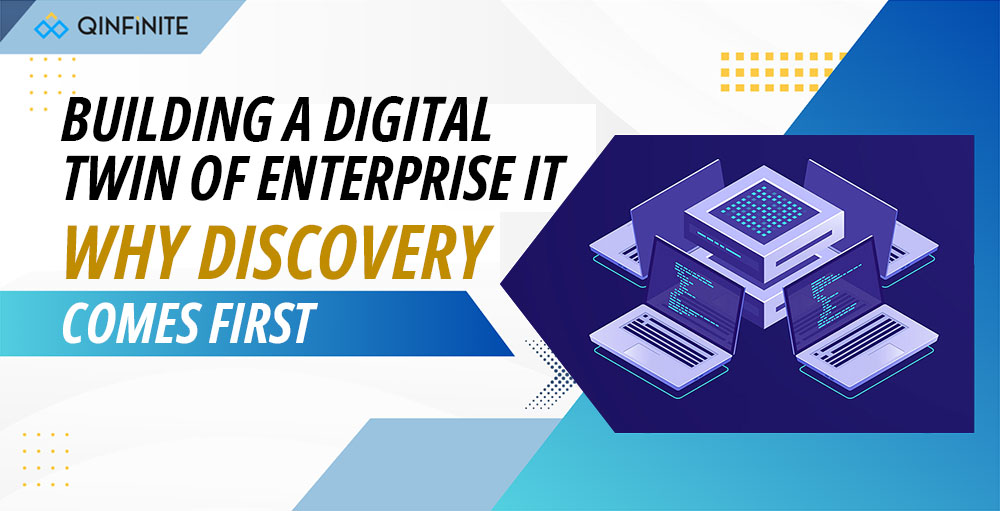
A digital twin is a dynamic, real-time representation of your IT environment.
It reflects:
- infrastructure
- applications
- dependencies
- system behavior
This allows organizations to simulate changes, analyze risks, and test resilience strategies.
Why Discovery Comes First
A digital twin is only as accurate as the data behind it.
Without continuous discovery:
- systems go undetected
- dependencies remain hidden
- models become outdated
Discovery provides the foundation layer.
From Discovery to Knowledge Graph
Once systems are discovered, they must be connected.
Qinfinite transforms discovery data into a live Enterprise Knowledge Graph, mapping relationships across:
- applications
- infrastructure
- services
- business processes
This creates a contextual model of the entire IT ecosystem.
Enabling Chaos Engineering
With a digital twin in place, organizations can safely simulate failures.
Chaos engineering allows teams to:
- test system resilience
- identify weaknesses
- improve reliability
Instead of reacting to failures, enterprises can proactively prepare for them.
The Role of Agentic AI
As systems become more intelligent, AI plays a larger role.
Agentic AI workflows can:
- analyze system behavior
- detect anomalies
- trigger automated responses
This moves IT operations toward autonomous systems.
Where Qinfinite Leads
Qinfinite brings together:
- Auto-Discovery
- Enterprise Knowledge Graph
- Digital Twin modeling
- Chaos Engineering
- Agentic AI workflows
into a unified platform. This enables enterprises to move from reactive operations to predictive and intelligent systems.
Conclusion
The future of IT is not just about managing systems. It’s about understanding them, simulating them and continuously improving them. And it all starts with an efficient, intelligent and deep discovery.