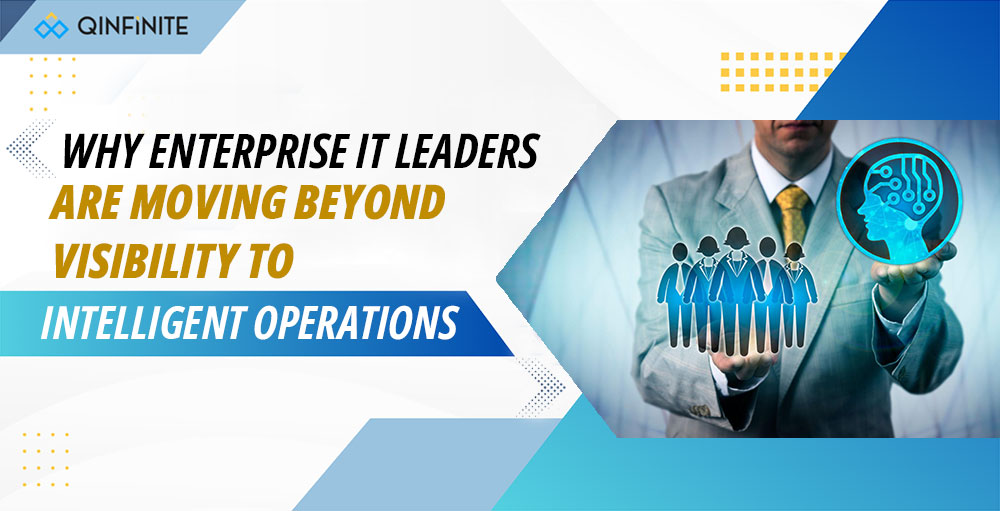
Introduction – Visibility Was the Goal. Now It’s the Starting Point.
For years, enterprise IT leaders have been chasing visibility by way of
- Better dashboards.
- More monitoring tools.
- Notification Alerts and More data.
And to a large extent, that goal has been achieved. Most organizations today can see what’s happening across their systems. But a new realization is setting in and that is enterprise IT leaders have come to understand and accept that seeing is not the same as understanding; and understanding is not the same as control.
The Illusion of Control
On paper, everything looks covered.
There are tools for:
- infrastructure monitoring
- application performance
- incident management
- asset tracking
But when something goes wrong, the same questions still surface:
- Where did this originate?
- What systems are affected?
- Why didn’t we see this coming?
- What’s the business and financial impact?
Because despite all the tools the system as a whole is still not fully understood.
The Problem Isn’t Data – It is Context
Modern IT environments are no longer linear. They are distributed, interconnected and constantly evolving.
A single business transaction may touch:
- multiple applications
- APIs
- cloud services
- legacy systems
And while data exists across each of these layers the relationships between them often don’t.
Without context:
- alerts become noise
- incidents take longer to resolve
- decisions carry uncertainty
Why Visibility Alone Is No Longer Enough
Visibility answers: “What is happening?”
But leaders today need answers to:
“Why is it happening?”
“What will happen next?”
“What should we do about it?”
This is where traditional approaches fall short.
Because they were built for:
- static environments
- predictable systems
- slower rates of change
That world no longer exists.
The Shift to Intelligent Operations
Leading CIOs are now moving toward a more intelligent way of operating IT.
This includes:
A Living View of the Environment
Not static inventories / outdated CMDBs – but continuously updated system maps.
Contextual Understanding of Dependencies
Knowing not just what exists, but how everything is connected.
Faster, More Accurate Decision-Making
With real-time insights into impact and risk.
Automation with Control
Using AI and agentic workflows to act – without losing governance.
From Monitoring Systems to Understanding Systems
There’s a fundamental shift happening from monitoring individual components to understanding the system as a whole.
This is where concepts like:
- enterprise digital twins
- real-time dependency mapping
- context-aware AI
are becoming critical, because they enable System-level intelligence.
Where Qinfinite Fits In
Qinfinite is built around this exact shift. It doesn’t just add another layer of monitoring.
It creates a real-time, living representation of your IT environment visible via the enterprise knowledge graph which also serves as a digital cum intelligent twin that continuously evolves.
This allows organizations to:
- understand how systems are connected
- identify risks before they escalate
- resolve issues faster with full context
- automate operations intelligently
So instead of reacting to problems enterprise IT leaders can operate with awareness and control.
A Different Way to Think About IT Leadership
The role of the CIO is evolving. It’s no longer just about managing systems, ensuring uptime or controlling costs. It’s about enabling the business to move faster, safer, and smarter; and that requires a deeper understanding of how technology actually works together.
The Bottom Line
Visibility was the first step. But it’s no longer the differentiator. In today’s enterprise, the question that defines modern IT leadership is not:
“Do we have visibility into our systems?”
It is:
“Do we understand our systems well enough to control them?”